



logo
EverydayChaos
Everyday Chaos
Too Big to Know
Too Big to Know
Cluetrain 10th Anniversary edition
Cluetrain 10th Anniversary
Everything Is Miscellaneous
Small Pieces cover
Small Pieces Loosely Joined
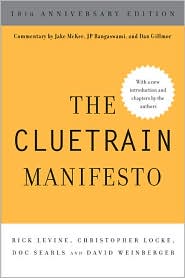
Cluetrain cover
Cluetrain Manifesto
My face
Speaker info
Who am I? (Blog Disclosure Form) Copy this link as RSS address Atom Feed

December 18, 2003

Scrubbing the .gov

The Daily Mislead reports that the Washington Post is reporting that the Administration is removing from its sites statements that have later turned out to be untrue.

Specifically, on April 23, 2003, the president sent his top international aid official on national television to reassure the public that the cost of war and reconstruction in Iraq would be modest… But instead of admitting that he misled the nation about the cost of war, the president has allowed the State Department “to purge the comments by Natsios from the State Department’s Web site. The transcript, and links to it, have vanished.”

A Bush spokesman said the administration was forced to remove the statements because, “there was going to be a cost” charged by ABC for keeping the transcript on the government’s site. But as the Post notes, “other government Web sites, including the State and Defense departments, routinely post interview transcripts, even from ‘Nightline,'” and according to ABC News, “there is no cost.”

All in good fun, I’m sure.


Dan Gillmor‘s got some excellent reportage that dives deep into this story.

Tweet
Follow me

Categories: Uncategorized Tagged with: politics Date: December 18th, 2003 dw

Be the first to comment »

Blood on blogs

My friend Rebecca Blood has a piece on blogs in The Guardian that tries to shift our enthusiasms about weblogs. I’m not entirely convinced by it.

She starts by saying that “no one really understands weblogs.” Fair enough.

She then puts holes in those who have described weblogs in “outrageously overblown terms”:

Enthusiasm abounds. Bloggers enjoy describing themselves as pioneers, though their ideas of innovation are sometimes suspect. “We are writing ourselves into existence,” some ecstatically proclaim, as if Pepys and Boswell and the historic legions of their fellow journal-writers had never existed.

As the guy who said “We are writing ourselves into existence,” I should maybe point out that I didn’t say that this was the first time we’ve ever done so. But I do believe that the Web is a new public space and weblogs enable us — all of us, not just the Pepyses and Boswells among us — to construct public selves in that space. So, what’s not new: Creating public selves. What is new: Doing so in this new public space and doing so primarily via written text, as opposed to via speech, writings, body language, clothing, etc. (On the other hand, I proudly admit to being way too enthusiastic about the Web and blogging.)

Then Rebecca dismisses those who “can conceive of weblogs only in terms of their own experience.” “A weblog is something fundamentally new,” she writes, and “those who try to define the phenomenon in terms of current institutions are completely missing the point.” (But if weblogs are something so fundamentally new that they bear no resemblance to current institutions, then why is the enthusiasm overblown? Aren’t we indeed pioneers?)

Then Rebecca explains the thing that she says no one has understood: Weblogs are, she says, “participatory media,” as opposed to either “passive news consumption” or broadcasting. Definitely, but I don’t think that’s enough to explain the thing that no one understands, that “no one can quite put their finger on…” We’ve had participatory media before — letter writing, CB radio, radio talk shows — but there’s something distinctive about the blogging form of participatory media. IMO, to see what’s distinctive about them, we should look at stuff like: their conversational nature, the way their dailyness requires anticipatory forgiveness of lapses in typing and thought, their embracing of the distinctiveness of voice, and, yes, the way blogs create public selves. That sort of thing. Of course, that’s really just to say that I would have written a different article than Rebecca, not a very useful comment.

Then she ends on terms that seem as overblown as the ones she criticizes:

…weblogs have changed personal publishing so profoundly that the old rules no longer apply. We are at the beginning of a new age of online publishing – and I predict that this generation of online pamphleteers is just the first wave.

Online pampleteers? I don’t want to make too much of this phrase since Rebecca had to wrap up somehow and probably didn’t want to say “participatory media” again. But pamphlets??

So, the take away is, I think: The enthusiasm for blogging is misplaced. Blogs are in fact a new form, called participatory media, that will change online publishing forever.

If I got that right, then I respectfully disagree with Rebecca; I think “participatory media,” while useful, takes us only some of the way towards understanding blogs. But I certainly agree that we haven’t understood blogging yet. That’s precisely why we should be encouraging a diversity of enthusiasms.

Tweet
Follow me

Categories: Uncategorized Tagged with: web Date: December 18th, 2003 dw

22 Comments »

Blood on blogs

My friend Rebecca Blood has a piece on blogs in The Guardian that tries to shift our enthusiasms about weblogs. I’m not entirely convinced by it.

She starts by saying that “no one really understands weblogs.” Fair enough.

She then puts holes in those who have described weblogs in “outrageously overblown terms”:

Enthusiasm abounds. Bloggers enjoy describing themselves as pioneers, though their ideas of innovation are sometimes suspect. “We are writing ourselves into existence,” some ecstatically proclaim, as if Pepys and Boswell and the historic legions of their fellow journal-writers had never existed.

As the guy who said “We are writing ourselves into existence,” I should maybe point out that I didn’t say that this was the first time we’ve ever done so. But I do believe that the Web is a new public space and weblogs enable us — all of us, not just the Pepyses and Boswells among us — to construct public selves in that space. So, what’s not new: Creating public selves. What is new: Doing so in this new public space and doing so primarily via written text, as opposed to via speech, writings, body language, clothing, etc. (On the other hand, I proudly admit to being way too enthusiastic about the Web and blogging.)

Then Rebecca dismisses those who “can conceive of weblogs only in terms of their own experience.” “A weblog is something fundamentally new,” she writes, and “those who try to define the phenomenon in terms of current institutions are completely missing the point.” (But if weblogs are something so fundamentally new that they bear no resemblance to current institutions, then why is the enthusiasm overblown? Aren’t we indeed pioneers?)

Then Rebecca explains the thing that she says no one has understood: Weblogs are, she says, “participatory media,” as opposed to either “passive news consumption” or broadcasting. Definitely, but I don’t think that’s enough to explain the thing that no one understands, that “no one can quite put their finger on…” We’ve had participatory media before — letter writing, CB radio, radio talk shows — but there’s something distinctive about the blogging form of participatory media. IMO, to see what’s distinctive about them, we should look at stuff like: their conversational nature, the way their dailyness requires anticipatory forgiveness of lapses in typing and thought, their embracing of the distinctiveness of voice, and, yes, the way blogs create public selves. That sort of thing. Of course, that’s really just to say that I would have written a different article than Rebecca, not a very useful comment.

Then she ends on terms that seem as overblown as the ones she criticizes:

…weblogs have changed personal publishing so profoundly that the old rules no longer apply. We are at the beginning of a new age of online publishing – and I predict that this generation of online pamphleteers is just the first wave.

Online pampleteers? I don’t want to make too much of this phrase since Rebecca had to wrap up somehow and probably didn’t want to say “participatory media” again. But pamphlets??

So, the take away is, I think: The enthusiasm for blogging is misplaced. Blogs are in fact a new form, called participatory media, that will change online publishing forever.

If I got that right, then I respectfully disagree with Rebecca; I think “participatory media,” while useful, takes us only some of the way towards understanding blogs. But I certainly agree that we haven’t understood blogging yet. That’s precisely why we should be encouraging a diversity of enthusiasms.

Tweet
Follow me

Categories: Uncategorized Tagged with: web Date: December 18th, 2003 dw

1 Comment »

December 17, 2003

Nine stories

The fabulous Jay Rosen is doing his bit to pry open the narrative bear trap clamped around the legs of journalists — nine ways you could cover the election campaign without once using the language of sports or show biz. What a concept(s)!

Tweet
Follow me

Categories: Uncategorized Tagged with: politics Date: December 17th, 2003 dw

4 Comments »

Governance by citizenry

How are we going to implement in governance the Net-based citizen involvement that the campaign has initiated? Here’s one idea.

Let’s say you care about the e-voting scandal that’s just waiting to happen. So, you go to your Senator’s site. There you find a “Citizen-to-Citizen” (C2C) page that lists the current issues constituents are discussing. A search for “e-voting” turns up nothing, so you are now prompted to create a C2C group on the topic. You write up your description of the problem and include some supporting links. Automatically, a new space is created with its own page and with the sort of collaborative capabilities were coming to expect: shared library, email archive, threaded discussion, maybe a MeetUp link, etc. Anyone who cares about the issue can find your space and join the conversation. (People can also register as caring about the issue without having to participate in the issue space.)

The site automatically reports metrics so that the most popular issues are surfaced. The Senator sees that there’s been a lot of activity in the e-voting issue space, votes to ban e-voting machines that don’t have some type of acceptable audit capability, and our democracy is saved. It’s just that simple!

Forget the implementation details. What I like about this ideas is its focus on connecting citizens who share interests, rather than on tabulating polls or instant ballots. It’s a way, potentially, of handling the scaling issues that turn citizens into data points. Democracy is a conversation, after all.

(This idea was sparked by conversations with Jock Gill and Britt Blaser, neither of whom should be assumed to agree with it.)

Tweet
Follow me

Categories: Uncategorized Tagged with: politics Date: December 17th, 2003 dw

6 Comments »

Competition as a four letter word

An article in the Boston Globe (the link dies tomorrow) by Keith Reed reports that Song, Delta’s budget branch, is installing high-end entertainment systems on its planes. JetBlue is about to start serving the same market:

Yet neither carrier will admit that they are headed toward direct competition on price or amenities here, even as they head for a duel of one-upmanship with their entertainment offerings.

“It isn’t that Song and JetBlue are coming into Boston to compete,” said Tim Mapes, Song’s managing director of marketing. “We’re simply making sure that we’ve got a mix of products that people want.

Since when is it bad for companies to admit that they’re competing? Because competition implies a finite market? Whom do they think they’re kidding? Or did the hippies finally win?

Tweet
Follow me

Categories: misc Tagged with: misc Date: December 17th, 2003 dw

2 Comments »

December 16, 2003

The David-Centric Universe

Apparently it’s all about me today. I’ve been paynted — you know, Frank Paynter’s long-form interview. (Please ignore the boxed testimonials. I’ve asked Frank to remove them.)

Tweet
Follow me

Categories: misc Tagged with: misc Date: December 16th, 2003 dw

8 Comments »

Audio interview with moi

You can listen to Doug Kaye’s interview of me at the ITConversations site. I pontificate about the Dean campaign and e-democracy.

Tweet
Follow me

Categories: Uncategorized Tagged with: politics Date: December 16th, 2003 dw

1 Comment »

Levy on the Death of the Internet

Steven Levy in Newsweek has an excellent and scary column on why Big Forces want to lock down the Internet and how they’re doing so under the guise of “trusted computing” and other industry efforts.

Here’s the John Walker he talks about. And Jon Husband points us to this Paul Hughes piece on VoIP’s challenge to the telcos.


Eric is pissed by the Levy article. I really disagree with Eric’s argument that DRM, “trusted computing,” et al. are neutral technologies because they can be used for good or evil.

Well, sure, you could mug someone by threatening him with a hypodermic full of polio vaccine, but if we look at the technology and the context into which it’s being introduced, I’m willing to say that polio vaccine is good and DRM et al. is (not nearly as unambiguously) bad.

Whether I’m right or wrong about DRM et al., I’ll still argue that we need to discuss the likely moral/social impact of technologies. Discuss and act. In fact, I like Eric’s closing: “Wanna do something about it? Great. Start a company. Write a program. Come up with a business plan.” (And for those of who write: Write something!)

Tweet
Follow me

Categories: Uncategorized Tagged with: web Date: December 16th, 2003 dw

1 Comment »

Phenomenal Photos

Some jaw-dropping scientifical photos here, suitable for framing.

Tweet
Follow me

Categories: misc Tagged with: misc Date: December 16th, 2003 dw

Be the first to comment »

« Previous Page | Next Page »


Creative Commons License
This work is licensed under a Creative Commons Attribution-NonCommercial-ShareAlike 3.0 Unported License.
TL;DR: Share this post freely, but attribute it to me (name (David Weinberger) and link to it), and don't use it commercially without my permission.

Joho the Blog uses WordPress blogging software.
Thank you, WordPress!