



logo
EverydayChaos
Everyday Chaos
Too Big to Know
Too Big to Know
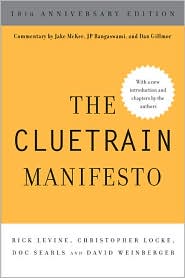
Cluetrain 10th Anniversary edition
Cluetrain 10th Anniversary
Everything Is Miscellaneous
Small Pieces cover
Small Pieces Loosely Joined
Cluetrain cover
Cluetrain Manifesto
My face
Speaker info
Who am I? (Blog Disclosure Form) Copy this link as RSS address Atom Feed

October 19, 2003

Costikyan on “Piracy”

Greg Costikyan speaking the truth about the attempts to “fix” the “piracy” “problem.” An excerpt:

The whole “antipiracy” thing is not ultimately about preserving the rights of artists. It’s about preserving the value of intermediaries who have already fucked over the artist. And from a purely ethical perspective, I don’t see why the intermediaries have a leg to stand on.

Tweet
Follow me

Categories: Uncategorized Tagged with: web Date: October 19th, 2003 dw

2 Comments »

October 18, 2003

[POPTECH] TransHab

Constance Adams, a NASA architect, is telling us about TransHab, an inflatable living place for space travelers.

Two surprising (to me) aspects of living in no gravity: hot air doesn’t rise so airflows have to be redesigned, and sweat floats so electrical outlets need to be sweat-proof.

The initial design of TransHab didn’t design around the needs of the astronauts. “These are great engineers. Give them the right problem and they will sovle the hell out of it.” E.g., the astronauts need to be able to meet together and see one another, which means building a big enough area. How wide is too wide? In Space Lab there was 6.5 meter space. An astronaut fell asleep without being tethered and found it to be a wide area to navigate.

“If you can’t draw it, forget it.” In all of the drawings of the TransHab, no one had the guts to show astronauts sitting upside down relative to one another. Constance said that showed a flaw in the design.

They designed a galley that works like a kitchen, a first. (“On the shuttle, the galley’s next to the toilet. That’s always good.”) The kitchen table rests on a slow helix so that people of all heights can sit on the helix.

Constance noticed that designing TransHab’s outer shell faces the same problem as confronted by people weaving baskets.

She ends with a plea for caring about exploring space and for understanding the earth as a beautiful, closed system.

Whitfield Duffie asks if TransHab will accommodate sex since it is a wet activity. Constance replies that it’s designed to filter all sorts of fluids, but that in a body in zero gravity, fluids tend to gather in the head and feet, not the right places for sex.

Constance says that the ideal person for a flight to Mars is a 55 year old woman, but she doesn’t elaborate. [I myself am quite fond of women around the age of 55. Well, one anyway.]

Great talk. So much that was new, at least to me.


Jonathon Coulton is about to sing a song. The one he sang yesterday was very funny.

Tweet
Follow me

Categories: Uncategorized Tagged with: tech Date: October 18th, 2003 dw

Be the first to comment »

[POPTECH] Hydrogen

Jeffrey Ballard of General Hydrogen: Fuel cells will be big.

Service technologies, not energy sources, drive energy systems.

Hydrogen lets you use any primary energy source as your source of hydrogen: coal, nuclear, wind, hydro, etc.

Hyrdogen cars will be able to produce electricity where you need it.

When will we see hydrogen cars in a show room? Jeffrey thinks that the current technology doesn’t have the duration need for commercial success. We’re still stuck on the first type of design we came up with that work. And he says that we need to get the cost down to $0.10/kw. It’s currently at $10.00/kw. [As always, I may have gotten key units wrong. Damn facts!]

He believes that we will turn to nuclear energy as a safe and clean source.

Tweet
Follow me

Categories: Uncategorized Tagged with: tech Date: October 18th, 2003 dw

6 Comments »

[POPTECH] Wireless

Dewayne Hendricks is talking about wireless communications. “Any sufficiently advanced technology is indistinguishable from magic”: Clarke’s third law. Wireless connectivity is the closest thing we have to magic.

Communications used to be limited to the speed of travel. Then Marconi happened at the turn of the 19th century. The Titanic disaster spurred government regulation because of interference in the help transmission. In 1934, the FCC was formed, locking us into a property model of communication.

Dewayne talks about his youth as a ham operator. Now with wifi, “everyone becomes a ham.” Unlike hams, you don’t have to go through the centralized bureaucracy to participate.

He points to problems with the property model. Basically, the needs of the market don’t reflect the band assignments made years ago. It’s discouraged innovation. Dewayne wanted to experiment in some frequency that couldn’t be freed up, so he was told to find a country with open access to spectrum. The crown prince of Tonga heard about a high-speed wireless net he’d set up. Dewayne’s company (Dandin Group) is now a common carrier in Tonga.

For an existence proof in the US, Dewayne installed on Indian reservations since they (presumably) have rights to their spectrum. And it worked.

Dewayne talks about the California Gigabit Initiative to bring gigabit access (upload and download) by 2010. He’s in charge of figuring how to bring wireless gigabit everywhere. “The problem will be political, not technical.” Nothing is holding it back but the command and control, property view of spectrum.

We need a new paradigm, Dewayne says. We need “Open Spectrum.” Cognitive radio can take advantage of it.

He ends by citing Tom Freeburg, Motorola’s chief futurist until he retired recently, talking about the real possibility of a Star Trek style transporter.

Tweet
Follow me

Categories: misc Tagged with: misc Date: October 18th, 2003 dw

Be the first to comment »

[POPTECH] IP

David Martin says that businesses and institutions knowingly inflate the value of their patents in order to pump themselves up. He says that this is a major scandal that will break soon.

Tweet
Follow me

Categories: misc Tagged with: misc Date: October 18th, 2003 dw

Be the first to comment »

[POPTECH] Virginia Postrel

She’s going to talk about the substance of her style (her book), but also will argue that progress is incremental, that we should appreciate change over time, and that “the desires of ordinary people matter and deserve respect.”

Art, she argues, means “making special.” Even the desperately poor do this: they paint their dwellings, embroider their rags.

Design has three purposes: Function, pleasure and meaning. Biological pleasure is universal, but fashion is cultural. Meaning can be an association or identity (standing out and fitting in [Saussure!]) “The substance of style can be summed up in two sentences: I like that. I’m like that. Pleasure and identity.

We are in the Age of Aesthetics. That means that on the margin we try to make things special, “enhancing the look and feel of people, places and things.” And there’s more aesthetic competition: it’s a key part of product design and store “experiences.” There are more aesthetics in more aspects of life. Everyone uses fonts and pictures when doing the simplest of documents.

This is a big change. For a hundred years, the big news was that you got stuff. We wanted it to be standardized, e.g., hotel rooms and fast food. Function but not style. Now we want more. And not just in hotel rooms: 71% of US women 45-54 dye their hair to cover gray, and 13% of men. But color sales among young men are up 25% in 5 years. Teen boys spend 5% of their income on hair color.

Aesthetics is becoming the killer app for information technology.

[Hmm. I’m not convinced. Things have always been designed, even the dwellings of the poor, as she says. So, what’s really different? The styles have changed, but have we really dropped style itself? Isn’t poured concrete a type of style? Ah, now in response to a question she’s pointing to the new willingness to accept a diversity of styles.]

Tweet
Follow me

Categories: misc Tagged with: misc Date: October 18th, 2003 dw

1 Comment »

[POPTECH] James Howard Kunstler

No point in trying to summarize this brillilant and hilarious presentation. James Howard Kunstler is showing photo after photo of American architectural monstrosities that are, unfortunately, all completely normal for us: industrial civic buildings, antisocial main streets, schools that are jails. He recommends “the new urbanism.”

Did I mention that he’s brilliant and hilarious?

Tweet
Follow me

Categories: misc Tagged with: misc Date: October 18th, 2003 dw

1 Comment »

[POPTECH] Xeni and Kevin on Weblogs

Xeni Jardin is talking, with Kevin Sites attending from Iraq online. She was responsible for getting Kevin (the CNN war correspondent) started blogging. (Sites apparently hasn’t logged in). We see some footage of his war coverage. But because Kevin isn’t online, Xeni’s doing some ad hoc presentation management.

Tweet
Follow me

Categories: misc Tagged with: misc Date: October 18th, 2003 dw

Be the first to comment »

[POPTECH] Weblog

Clay Shirky is going to talk about “Weblog Ecosystem: Power Laws, Fake Estates, Weblogs and the Media.” He defines weblogs as anyting that is simple enough to enable anyone to publish on the web, every day if she or he wants to. (Not a close enough quote, unfortunately.) He’s talking about power laws.

Blogs form loose conversations. Link density grows according to Metcalfe’s Law. (Metcalfe is in the audience; he’s one of the founders of PopTech.) Preferential connectivity. Sites can scan the weblog world and see the links. “Link structure is a proxy for audience.” That is, if there are lots of inbound links, there are probably lots of readers.

Clay in February checked Technorati to see the distribution of links and found a power law curve: a very rapid collapse and then a long, slow tail. (Clay says that Jason Kottke had the same idea at the same time.) This is definitely not a bell curve. Most bloggers have less than average traffic. Half the link density is taken up by just 5% of the weblogs. And adding more bloggers makes the curve even steeper: if you start a blog, you are likely to link to one of the top weblogs but they are quite unlikely to link to you.

The links in the tail tend to be among people linking to one another, the pattern of a dinner party. At LiveJournal, people aren’t posting in public; they’re posting to friends. “You could go down to the mall and sit in the food court, and listen in on a conversation among a bunch of teenagers … but you’re the weird one, not them.”)

The links at the top form a broadcast pattern. Glenn Reynolds can’t link back to everyone who links to him. He has too many readers to be able to open up comments.

These patterns apply outside of the world of weblogs. Power laws apply in many places. E.g., of word frequencies follows a power law.

The 20th century was the century of mass media. We’re comfortable with that. Weblogs are a rapid “do-over” of the 21st century. It’s the first medium we’ve seen go from zero to important. But there are three differences from mass media:

1. No central control

2. No special technology – a teenager bitching about his parents and Glenn Reynolds use the same technology. The same technology scales across 7 orders of magnitude.

3. No scarcity. It’s “fake estate” not “real estate.” Construction increases the size of the system rather than taking some of it out of circulation.

The differences among the patterns of weblog connectivity are all social differences, not technological ones. So, what does this mean for us?

First, “Broadcast happens.” Even though blogs are two-way, the broadcast pattern has re-emerged. “The broadcast pattern arises out of the social wiring of large groups of people.”

[Yeah but…broadcast reemerges, but it non-broadcast clusters also emerge. That long tail has a lot of people in it. Sorry to be a fanatic, but look at how Dean supporters are organizing themselves. And Clay points to Oprah Winfrey’s book clubs as an example of an attempt to put clusters — local book clubs — at the edges of the broadcast spokes.]

Second, “There is an A List (and you’re not on it).”

Third, “Freedom vs. Equality.” When you increase the freedom in the system, you get imbalances and power curves.

Q: [Me] It’s not that broadcast is all there is; the length of the tail shows the importance of non-broadcast.

A: Yes.

Q: How many weblogs will there be?

A: See the Perseus study.

Q: How about the changing role of authority?

A: The next move is to derive expertise from the link structure. It hasn’t happened yet but it will because it has to.

Clay is, of course, brilliant but he’s also a brilliant presenter. He argues for a point, shows its broad impact, and gets laughs from the audience just by being smart. Yikes.

Tweet
Follow me

Categories: Uncategorized Tagged with: web Date: October 18th, 2003 dw

12 Comments »

Kevin Rips and Burns S. Jobs

From Kevin Marks via email:

At the iTunes Music launch, Jobs said something very wrong – that record labels should be the arbiters of taste – that they edit for our own good, and that unsigned bands need not apply.

The key point of digital media is that we can all edit, so I edited him.

Direct links to the streams of me ripping and mixing Jobs & Sarah:

300kbit

100kbit

Tweet
Follow me

Categories: Uncategorized Tagged with: web Date: October 18th, 2003 dw

1 Comment »

« Previous Page | Next Page »


Creative Commons License
This work is licensed under a Creative Commons Attribution-NonCommercial-ShareAlike 3.0 Unported License.
TL;DR: Share this post freely, but attribute it to me (name (David Weinberger) and link to it), and don't use it commercially without my permission.

Joho the Blog uses WordPress blogging software.
Thank you, WordPress!