


logo
EverydayChaos
Everyday Chaos
Too Big to Know
Too Big to Know
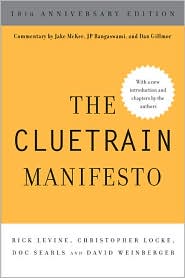
Cluetrain 10th Anniversary edition
Cluetrain 10th Anniversary
Everything Is Miscellaneous
Small Pieces cover
Small Pieces Loosely Joined
Cluetrain cover
Cluetrain Manifesto
My face
Speaker info
Who am I? (Blog Disclosure Form) Copy this link as RSS address Atom Feed

April 7, 2003

Highways and Networks

David H. Deans, founder of the Economic TeleDevelopment Forum is presenting a paper on what we can learn about broadband deployment from the building of the US highway system. (The conference is in Barcelona, the lucky devil.) In an email, David explains why he thinks local governments should be added to the list of the clueless:

A case in point — I received an email from an leader in a fourth-tier municipality in the U.S., he told me that his staff was concerned about the implications of WiFi hot spots, and wanted me to recommend some non-technical online resources so he could inform himself about this issue. I gave him some sites to visit, and I asked if his staff was anxious about a lack of hot spots in their local community (the Digital Divide is still a hot topic, especially within inner-city and rural areas). To my surprise, he told me that this was NOT their concern, instead they were concerned about the potential loss of revenue — how would they tax WiFi services?

Here, from the paper, is a table of the cost per kilometer of deplying infrastructure:

Road: $550,000
Water: $195,000
Electricity: $145,000
Gas: $85,000
Fiber Optics: $22,000 – $35,000
Coaxial Cable: $12,000 – $20,000
Copper: $7,000 – $15,000
Wireless: $3,500 – $15,000

You can read the paper here, although it’s in Word format.

Tweet
Follow me

Categories: Uncategorized Tagged with: web Date: April 7th, 2003 dw

4 Comments »

George Lakoff Is Like a …

Let me begin with the standard-issue praise, which is no less sincere for being completely predictable: George Lakoff and Mark Johnson’s Metaphors We Live By helped shape my thinking. Their book Philosophy in the Flesh is a truly fresh and mind-pivoting look at philosophy. I thank them for all that I’ve learned from them. (And now comes the “But…”)

But Dr. Lakoff’s most recent op-ed comes close to self-parody.

Lakoff has a superb eye for pointing out how what we take as straightforward, factual descriptions are in fact highly metaphorical — everything from talking about “high” notes to “straightforward” descriptions. He watches how these metaphors cluster (why are things that are “down” sad or mournful, and how does “falling” in love fit into that?) and convinces us that reality doesn’t lurk “behind” metaphors but is only understandable “through” metaphors.

In his new op-ed, Lakoff points to the metaphors we use in understanding the Iraqi war: The Nation as Person, the International Community with its “advanced” and “backward” nations, the war’s “gains” and “assets,” etc. It’s helpful to be reminded that when we say that the war isn’t against the Iraqi people, it’s against Saddam, even our smartest bombs aren’t listening to how we speak.

But pointing out that something is a metaphor just isn’t enough. The op-ed reads almost as if Lakoff is using a random quotation marks generator. Since all language and understanding is metaphorical, “you” can “slap” quotes “around” every “word” in “a” sentence. So, ok:

One of the most frequent uses of the Nation As Person metaphor comes in the almost daily attempts to justify the war metaphorically as a “just war.” The basic idea of a just war uses the Nation As Person metaphor plus two narratives that have the structure of classical fairy tales: The Self Defense Story and The Rescue Story.

Reduced to simple enough terms, everything is like everything else. But the question is: Is this a just war? Is it a war we should be waging? Lakoff says no: The connection between Iraq and Al Qaeda is too tenuous for the war to be in self-defense, although he’s less clear about whether we’re actually rescuing the Iraqis. Agree or disagree, how does Lakoff’s presentation of our justifications as “stories” help? Why not just say that Bush says we’re in Iraq to defend ourselves from terrorist attacks because he believes that there’s a connection between Iraq and Al Qaeda? Why frame this in terms of a fairy tale?

Certainly that framing suggests the story isn’t true. But if all understanding on such a scale is metaphorical — including Lakoff’s own — why isn’t labeling The Self Defense story a fairy tale just name-calling? In the op-ed, Lakoff says:

Millions of people around the world can see that the metaphors and fairy tales don’t fit the current situation, that Gulf War II does not qualify as a just war — a “legal” war

So, apparently, there’s a way to view “the current situation” outside of the frame of metaphors, seeing how the metaphor fits “the situation.” But Lakoff also writes:

One of the fundamental findings of cognitive science is that people think in terms of frames and metaphors — conceptual structures like those we have been describing. The frames are in the synapses of our brains — physically present in the form of neural circuitry. When the facts don’t fit the frames, the frames are kept and the facts ignored.

It is a common folk theory of progressives that “The facts will set you free!” If only you can get all the facts out there in the public eye, then every rational person will reach the right conclusion. It is a vain hope. Human brains just don’t work that way. Framing matters. Frames once entrenched are hard to dispel.

(Hard or impossible? These two paragraphs seem to disagree. Anyway…) If facts won’t do it, then what will? Lakoff ends the piece — lamely, IMO — by suggesting how to build a progressive, anti-war movement:

First, the anti-war movement, properly understood, is not just, or even primarily, a movement against the war. It is a movement against the overall direction that the Bush administration is moving in. Second, such a movement, to be effective, needs to say clearly what it is for, not just what it is against.

Third, it must have a clearly articulated moral vision, with values rather than mere interests determining its political direction.

Isn’t the more consistent conclusion that the anti-war movement needs new stories, new metaphors, a new framing?

Perhaps Lakoff thinks that coming up with new metaphors is too hard, a job for poets that we cannot reasonably demand, nor can we wait for. If not metaphors and facts, what’s left? Values! Values apparently can do what facts cannot. But isn’t it a common folk theory of progressives that “The values will set you free!” If only you can get all the real values out there in the public eye, then every feeling person will reach the right conclusion.

I want to believe that. And yet I also have seen that the same values, the same human responses to suffering, result in radically different political outcomes. The same clips of the injured Iraqis in hospitals are used to dissuade us from war and to show us how compassionate we are towards the handful of unintended victims. The photos of AIDS sufferers in Africa are used to justify international charity, Christian outreach, denunciations of the World Bank and hatred of the regimes that have done too little. Shared values without shared metaphors and stories do not result in shared action.

I’d suggest that when George Soros, Strom Thurmond, Saddam Hussein and Sally Struthers can all point to the same suffering, the anti-war movement isn’t going to succeed by announcing its values. Rather, we really do need a new Story and new metaphors. That and globally connected communities, new leaders, and, yes, the shortcut of money.

(Thanks to Doc for the link, to AKMA for the reminder, and to Rainer Brockerhoff for the discussion.)

Tweet
Follow me

Categories: Uncategorized Tagged with: philosophy Date: April 7th, 2003 dw

9 Comments »

April 6, 2003

Teenage Blogs

Here are two teenage blogs, one from my nephew, Joel Weinberger, and the other from his friend. Miles (“From Nowhere”) Klee. This is from Miles‘:

Today I was subjected to, by far, the most cruel lineup of exams, ever, on earth, ever, in history, ever: European history document-based-question, followed by calculus cumulative multiple-choice and open-ended midterm, followed by an easy but hulking Latin translation and four billion mundane questions. Okay, it wasn’t so bad, but it was no picnic, either. Mrs. Stanca didn’t even let us read or talk once we had finished, with the result that I had to sit and stare at my paper for 50 minutes or so. Once a bitch, always a bitch, what I say.

And this is from Joel‘s

Rutgers academic challenge this weekend. Woo-hoo. I just hope we suck as much as I think we do, so that way we get eliminated quickly and painlessly, and therefore we have no more practices.

My mom’s in West Virginia until the middle of next week, so I have the house to myself most of the time. Par-tay. Oh, yeah, that’s right, I don’t host parties. But if I did, this would be a perfect week to do so. There still are benefits to my mom being out, though, like getting subs for dinner tonight. Score.

And then there’s their friend Matt who’s been writing about Robin…

You want a fast course in the side of your nephew’s life that never comes up at family get-togethers? It’s right here…

Tweet
Follow me

Categories: Uncategorized Tagged with: web Date: April 6th, 2003 dw

8 Comments »

April 5, 2003

Politicizing the Infrastructure

Akamai has decided to jettison its customer, Al-Jazeera, for reasons it won’t talk about. Al-Jazeera is, of course, the Arab satellite news channel. It had asked for help from Akamai in dealing with hackers and general server overload.

It’s hard to imagine that this is anything but a political decision by Akamai. As many have pointed out, one of Akamai’s cofounders was on one of the flights that was crashed into the World Trade Center, so it is understandable that this is an especially sensitive issue for Akamai. But Arabs are not terrorists and Al-Jazeera isn’t Al Qaeda.

I know Al-Jazeera isn’t an objective source of news, but it’s a real good way to see how much of the world is seeing what CNN is presenting to us in unabashedly jingoistic terms. I’d rather have multiple points of view than just one, even if that one could be known to be the “best.” Akamai’s decision detracts from the Net’s value.

(Thanks to Paul Lehrman for the links to two MSNBC articles, here and here.)

Tweet
Follow me

Categories: Uncategorized Tagged with: politics Date: April 5th, 2003 dw

7 Comments »

Ratio…

From an email from the oddly delightful Mike O’Dell:

from the Disconcerting Analogies Department….

Egg Salad is to Chicken Salad

as

X is to Y

solve for X and Y

Tweet
Follow me

Categories: Uncategorized Tagged with: humor Date: April 5th, 2003 dw

3 Comments »

April 4, 2003

$Million Idea #347

Interface an optical sensor and a cable box so that we can change channels, adjust volume, etc., just by using hand gestures.

Drawback: Men all over the country will start misplacing their hands.

Tweet
Follow me

Categories: misc Tagged with: misc Date: April 4th, 2003 dw

3 Comments »

Orlowski’s NewSpeak

Kevin Marks takes Andrew Orlowksi to task for his rant about how an altered meaning of “second superpower” came to dominance on Google.

Orlowski spends some of his rant dollars complaining that the term changed its meaning (from “global popular protest” to something like “the emergent democracy enabled by the Internet”), some on his dislike of the thinking behind the phrase, and the rest on the injustice that Google changed its ranking because “A-List” bloggers picked up on it. So what, so what, and so what? The article by James Moore that has irked Orlowski explicitly moves from the second superpower as the “world peace movement” to the way in which the Internet is enabling that peace movement to become more than a disconnected set of marches. That’s how catchy phrases change their meaning as they are absorbed. And, yes, getting lots of links will boost your Google PageRank; Orlowski ominously calls this “Google … being ‘gamed'” by which he seems to mean simply that Google pays too much attention to weblogs. As for the sloppy thinking, yeah, sure, it’s a sloppy thought, as most good ideas are at first, but Orlowski counters it by name-calling.

Worse, Orlowski’s comparisons to 1984‘s NewSpeak are dangerously wrong. NewSpeak is a totalitarian government’s intentional subversion of language by changing the meaning of the culture’s most important, elemental words: Peace becomes war, freedom becomes slavery, etc. James Moore and the bloggers who linked to him aren’t a totalitarian power, and Moore only shaded the meaning, not cynically reversed it. Further, the phrase isn’t an elemental term; according to Orlowski, it was coined just this February. Orlowski seems to have confused folk music with a totalitarian state’s national anthem.

We shouldn’t let Orlowski cheapen the idea of NewSpeak this way. To compare “A-List” bloggers to a totalitarian government is ridiculous given the shamefully narrow range of opinion in the mainstream media. NewSpeak is real. With the capitulation of mainstream journalism, the Internet – where citizens like James Moore and Andrew Orlowski can put ideas good and bad into circulation – offers our best protection from it.

Tweet
Follow me

Categories: Uncategorized Tagged with: politics Date: April 4th, 2003 dw

5 Comments »

April 3, 2003

Just back

After 28 hours of travel (Florence to Zurich, overnight in Zurich, Zurich to Boston), we’re back. 950 emails to go through. A headache the size of the Duomo. I’ll blog tomorrow…

Tweet
Follow me

Categories: Uncategorized Tagged with: uncat Date: April 3rd, 2003 dw

Be the first to comment »

« Previous Page


Creative Commons License
This work is licensed under a Creative Commons Attribution-NonCommercial-ShareAlike 3.0 Unported License.
TL;DR: Share this post freely, but attribute it to me (name (David Weinberger) and link to it), and don't use it commercially without my permission.

Joho the Blog uses WordPress blogging software.
Thank you, WordPress!