



logo
EverydayChaos
Everyday Chaos
Too Big to Know
Too Big to Know
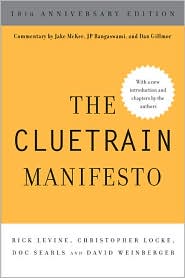
Cluetrain 10th Anniversary edition
Cluetrain 10th Anniversary
Everything Is Miscellaneous
Small Pieces cover
Small Pieces Loosely Joined
Cluetrain cover
Cluetrain Manifesto
My face
Speaker info
Who am I? (Blog Disclosure Form) Copy this link as RSS address Atom Feed

April 23, 2003

[ETech] GNU Radio

This session’s topic — software-defined radios — is an important topic. Matt Ettus and Eric Blossom are the presenters.

It’s an important topic because we have a broadcast system based on the idea that the receivers of signals can only do one thing with the signal: turn it back into sound. But if a radio is programmable, we caa\n be much smarter about how we transmit information and we can do much more interesting things with the signal once the radio receives it.

The HD TV demo looked fine, although there were some “motion artifacts” caused by the player they’re using. You can play TV through your TV already, of course, but these guys are doing it without a dedicated tuner and HDTV card. And it’s all open source.

Says Eric: The politics are hairy. We’re waiting to see what the FCC does about the broadcast flag. There’s also a “preposterous” proposal that all analog-to-digital devices should shut down if they detect a watermark indicating protected content. But in general, the FCC has been good about software-defined radio; they see it as something that may redefine radio (says Eric).

Even the cheapest computers these days (e.g., 1gH PIII) is more than enough. They are targeting $300-$400 for the board that will turn your computer into a software radio.

[Eric, in response to a question, talks about the myth of interference and new studies of mesh networks showing that smart transmitters and receivers actually increase capacity. May I reference my article in Salon that explicates David Reed’s view on this? No? Sorry, too late.]

Tweet
Follow me

Categories: Uncategorized Tagged with: web Date: April 23rd, 2003 dw

1 Comment »

[ETech] O’Reilly Radar

This is a hastily-assembled session about what Tim O’Reilly and his pals see coming over the horizon. The room is crowded.

Rob Frederick, Amazon Web Services. “We consider Amazon.com to be a technology platform. Developers can use Amazon’s backend systems, get product information and customer comments, and create and innovate. Available through their free SDK: search, browse, sales rank, etc. You can use XSLT to pass parameters and Amazon.com will return info as html snippets.

He points to www.simplest-shop.com by a 19-yr-old Rumanian developer who puts his innovations into the open source community. Using his code, you can develop a store front that has features not found on Amazon.com. (Tim points to this as an example of a long term trend: “decomposing” the Net so that we can get data through multiple interfaces.) Another example: Yes.net looks up any song currently playing on a radio station anywhere in the US.

A guy from Bay Area Wide Inernet Access is talking. The demand for wifi is being driven by the inability of the infrastructure to do the last mile. Wifi apparently works real good.

Bunnie Huang is a lonely hardware guy here. “It’s physics, solder and assembler.” A guy built a heart machine doing wave forms out of a Game Boy Advanced. Bunnie is also working with Field Programmable Gate Arrays.

Andrew Phelps (a prof at RIT) is talking about Phank. It inserts its own additions and hacks into massively multiplier online games. E.g., if you meet someone new in Everquest, you can see if anyone else in your guild has met them. A real-time paging system can let you know when, for example, a dragon is about to be slain.. Phank supports its development efforts by selling t-shirts online. They’ve built up characters in the game and sold them on eBay for a couple of thousand dollars.

Pretty interesting session although I was hoping to be more amazed.

Tweet
Follow me

Categories: Uncategorized Tagged with: web Date: April 23rd, 2003 dw

5 Comments »

[ETech] Biological Computing

Eric Bonabeau is talking about “Inspiration from nature for designing computing systems.”

He begins with an exceptionally clear example of how ants “solve” the problem of finding the shortest route to a sugar cube. Those that discover the shortest path deposit the freshest pheromones. He now applies this to the Salesman Problem (shortest routes among multiple cities). [It involved math so I played Minesweeper until the scary symbols went away.]

He shows how this form of emergent programming can result in more efficient routing of packets.

Now he’s onto the “second lesson from nature: simple rules rule.” With ants, a small ant carrying a load will give up that load when it comes across a larger ant. This is apparently quite efficient as proven at CVS drugstores where workers were ranked in terms of productivity and organized into ant-like “bucket brigades.” [How appealing!]

Eric asks us to imagine a game in which we are assigned an aggressor and a protector. Each person has to try to put his protector between himself and his aggressor. The overall pattern of behavior is very hard to predict. Change the rules a little and you get a different outcome. And individuals’ explanations don’t really account for the way it turns out: people don’t know what they’re part of. But you can simulate this via bottom up modeling, and you can affect behavior through minor adjustments of the rules. E.g., SW Airlines did this for cargo routing and saved $10M a year with a 71% improvement at the biggest hubs.

Eric tells a cuationary tale about blindly following simple rules. For example, army ants may sometimes form a circular path and follow each other around, putting down more and more pheromone that causes them to march ever faster, until they die. [Ah, a metaphor for life.]

Lesson #3: No one has to be in control. His example: Ants randomly position themselves around a big item until by chance they are all pushing in the same direction. Also, nest construction by wasps.

How do we shape emergence? Great demo at the end: Give people a slip of paper saying who they like and who they hate. They are to move towards those they like and away from those they hate. With random initial conditions, we get the same pattern: a rotating line within a following circle. Eric ran the simulation and it was, well, cool.

Practical results: Self-organized satellite deployment, swarm-based senor networks, self-healing networks. Social control and world domination. Coming soon.

Glenn Fleishman asks: How do you model perversity, i.e., “particles” that purposefully don’t follow the rules. Eric says this asks what you do if the particles don’t like your rules. Answer: you can make the rules robust against perturbation. [Doesn’t this mean that you can make rules that result in particular behaviors that the particles — we — don’t recognize as bringing about that group behavior and that we don’t even want to follow?]

[Would someone like to tell me if this shows the importance of Wolfram or his irrelevance? Or neither, of course.]

FUN QUOTE: You never find mergers in nature. Only de-mergers.

Tweet
Follow me

Categories: Uncategorized Tagged with: web Date: April 23rd, 2003 dw

7 Comments »

[ETech] Conference Blog

Apparently the conference blog aggregator is a list of trackback links.

Tweet
Follow me

Categories: Uncategorized Tagged with: uncat Date: April 23rd, 2003 dw

Be the first to comment »

Role of Technologists in Politics

The first two sessions of the Emerging Tech conference raised the issue: What should technologists be doing to keep the Net free and content open?

Here’s my answer, as profound as it is detailed:

First, technologists should make technology that supports openness.

Second, technologists should explain that technology as clearly as they can.

Here’s an example.

Right now, we’re in a battle over how controlled content can and should be. Everyone (?) agrees that creators ought to be compensated for their efforts. The question is: Is it necessary, fair and good for creators to always be compensated, in a one-to-one way, for every encounter with their works? Should we shut down photocopiers because sometimes they are used to violate copyright? Should we shut down VCRs for the same reason? Should we prevent people from lending books to their friends? Should I have to pay the author again if I choose to reread her book? Nah. But somehow the entertainment industry has persuaded Congress that any uncompensated use constitutes piracy. Technologists ought to convince Congress that the attempt to lock down all usage is either impossible or carries with it such terrible side effects that it is undesirable.

And then they ought to hack the control mechanisms.

Tweet
Follow me

Categories: Uncategorized Tagged with: web Date: April 23rd, 2003 dw

Be the first to comment »

[ETech] Wednesday AM: DRM panel

Dan Gillmor is moderating a session on Digital Restrictions Management.

Joe Kraus of DigitalConsumer.com: Congress is thoroughly convinced that DRM is about ending theft. They do not see it at all as about openness, access and fair use. This is largely because Hollywood has been effective whereas Silicon Valley believes that if its recitation of facts didn’t work, it needs to re-state the same facts.

Wendy Seltzer of the Electronic Frontier Foundation. The law is being interpreted to mean that when you buy a DVD, you haven’t bought the right to use it as you please but only in DVD players acceptable to the content creators. The word “theft” shuts down all discussion. [What’s the counter?]

Bunnie Huang who did the X-Box hack is here as a DMCA victim. He hacked the XBox. He asks: After we undergo the massive hardware change required by Palladium, will we feel safer? Couldn’t we do it just as well today using technologies like PGP? Huang says that Microsoft says they’re not worried about the hardware hacks that could undo Palladium, e.g., something that goes in the memory slot to unprotect it. [Keep in mind that we’re being protected from ourselves.]

Cory Doctorow says that we’ve heard from nerd-determinists and nerd-fatalists. He says that the good news is that Napster built the largest collection of human creativity ever and did it totally bottom up. When the copyright law was used to “burn that library to the ground,” the library rebuilt itself. The bad news is that the problem doesn’t lie solely with Congress, the recording industry or Silicon Valley. It’s our fault: there were 57 million Napster users. That’s more than the number of votes W got in 2000. The real point is that copyright’s purpose is to build libraries, and its tactic is to compensate artists. Napster and Kazaa don’t have models for that and it’s a real problem. DRM is the answer to a question we shouldn’t be asking: How do we burn the library burned down for good? The real question is how do we come to some compromise by which there’s fair compensation. The “broadcast flag” isn’t a compromise; it gives the entertainment industry a veto over PC design.

Cory says: The next time someone says “We have to stop Internet privacy,” you should reply: “Rather than burning the library, let’s talk about how we can compensate artists.” [But the entertainment industry says that they are asking that question. They say that in order to enable compensation we have to turn off the free spigot, which means altering PCs, passing laws, etc. I think the compromise isn’t over the fact of compensation but over accepting that there will inevitably be some use-without-payment, just as there is when we record off the radio, make a back up of a VHS, etc.]

Joe: We’ve lost the debate on theft. The real debate is really over incumbents vs. innovators. We should stop talking about music and movies and begin talking about what we know about: technical innovation where investors are being sued for investing in Napster, etc.

Q: Will the inclusion of DRM in Office 11 give people a positive taste for it? The panel disagrees. [How about a Creative Commons license stamper for Office?]

FUN QUOTE. Cory: “The compensation for science fiction writing isn’t small, it’s historic, it’s quaint.” (approximate)

Tweet
Follow me

Categories: Uncategorized Tagged with: web Date: April 23rd, 2003 dw

1 Comment »

Where’s the ETech blog?

If you know where the O’Reilly Emerging Tech conference blog aggregation page is? If so, please send me email: [email protected]. Thanks.

Tweet
Follow me

Categories: Uncategorized Tagged with: uncat Date: April 23rd, 2003 dw

2 Comments »

[ETech] Opening Session: Howard Rheingold

Rather than rehashing his excellent Smart Mobs, Howard is urging this group of techheads to keep the Net free and use it to spread freedom to the real world. We should be users, not consumers, he says. End to End ought to be maintained. This group in particular should understand the regulatory environment. The technoids will be more effective by building new technologies rather than attempting to fight against the professional politicos. We need to create a “preserve” where we can invent the next generation; the preserve should include opening spectrum for more innovation.

He asks: Why not invent technology that lets us deal directly with musicians rather than having to go through the recording industry? [I don’t think that this is a technological issue so much as an economic one.]

Build platforms for self-organizing networks. Watch what happens with trust.

Design Principles: Support End to End and link to others.

In the Q&A, Howard says we need to get the defaults right when it comes to privacy. “Only geeks play with defaults.”

I ask: Since the default is about to flipped from anonymity to identity, what about digital ID? Howard: We need to know who we’re talking with although not necessarily tie it back to a real world identity. Cory follows up: Since these pseudonymous identities may represent groups or bots, what does that do to trust? Howard replies that so long as they act in a trustworthy way, we don’t need more ID than that.

[When I say “we,” I mean “the technically adept people here,” i.e., not me.]

Tweet
Follow me

Categories: Uncategorized Tagged with: web Date: April 23rd, 2003 dw

2 Comments »

Help the Burning Bird

From Jonathon Delacour, about Burning Bird:

As you are probably aware, Shelley has had a tough time financially over the past year and has recently announced the possibility that — because she cannot currently afford hosting — she may be forced to discontinue her weblog.

To ensure that Shelley can continue to blog, I have established a Keep the Bird Burning fund, with donations payable via PayPal. The full details are here.


Tweet
Follow me

Categories: misc Tagged with: misc Date: April 23rd, 2003 dw

3 Comments »

Voting Standards

From Stanley Klein:

There is an ongoing effort in IEEE to develop standards for voting systems. The project is under Standards Coordinating Committee 38. The web page is at http://grouper.ieee.org/groups/scc38/ There are two projects there. The main voting system standards project is P1583.

… I have long been concerned that the bulk of participation has been by representatives of voting machine manufacturers. …

This effort definitely needs increased participation by people who are expert in information security, interested in voting systems, and not part of the manufacturing community. As a minimum, it needs participation in the voting pool when the standard comes up for approval in the IEEE Standards Association.

Time is short. The next meeting is scheduled for May 19 and 20 in Columbia, MD. … There are email lists for which the archives are posted on the web site. The drafts are also posted there.

Please either get involved yourselves or urge colleagues to get involved…

Tweet
Follow me

Categories: Uncategorized Tagged with: tech Date: April 23rd, 2003 dw

1 Comment »

« Previous Page | Next Page »


Creative Commons License
This work is licensed under a Creative Commons Attribution-NonCommercial-ShareAlike 3.0 Unported License.
TL;DR: Share this post freely, but attribute it to me (name (David Weinberger) and link to it), and don't use it commercially without my permission.

Joho the Blog uses WordPress blogging software.
Thank you, WordPress!