
logo
EverydayChaos
Everyday Chaos
Too Big to Know
Too Big to Know
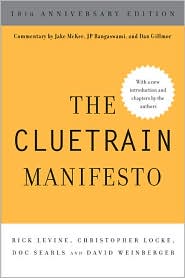
Cluetrain 10th Anniversary edition
Cluetrain 10th Anniversary
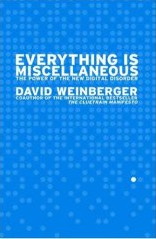
Everything Is Miscellaneous
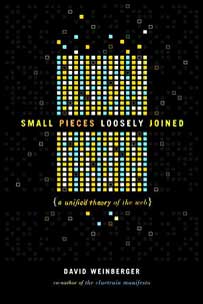
Small Pieces cover
Small Pieces Loosely Joined
Cluetrain cover
Cluetrain Manifesto
My face
Speaker info
Who am I? (Blog Disclosure Form) Copy this link as RSS address Atom Feed

March 15, 2003

Grimmelmann on DRM

James Grimmelmann at LawMeme shows the rest of us how to blog a conference. His report on the Boalt Digital Rights Management Conference is brilliant: hugely informative and entertaining. Anyone affected by DRM (i.e., everyone) should read it.
(Thanks to Arnold Kling for the link.)

Tweet
Follow me

Categories: Uncategorized Tagged with: web Date: March 15th, 2003 dw

Be the first to comment »

World of Ands

Michael O’Connor Clarke amends World of Ends to World of Ands. And it’s quite lovely.

Nice writing. Brave, too.

Tweet
Follow me

Categories: Uncategorized Tagged with: web Date: March 15th, 2003 dw

Be the first to comment »

March 14, 2003

Are There Ends on the Internet?

A few of the bloggers writing so well about the role of individual and community take Doc and me to task (or, better, to school) for portraying the Internet as a world of ends when in fact those ends are joined in webs of personal connection.

Of course that’s right. And since Doc is the “Web is a conversation” guy and I’m the “Small pieces loosely joined” guy, we’re on record as agreeing with that insight. So why do we misleadingly talk about “ends” in World of Ends? Good question…

First, that’s the language in the paper from which we took the article’s main insight: “End-to-End Arguments...” Second, Doc and I wanted to talk about the Internet’s architecture so that we could make the quasi-factual claim that boneheaded businesses and regulators are just plain wrong in their understanding; we didn’t want to focus in this article on all the good things that come out of that architecture. Third, we liked the echo of “ends” vs. “means” as in Kant’s Kingdom of Ends.

But, yes, absolutely and definitely, the value of the Internet is the groups it allows. In fact, point #7 is called “The end of the world? Nah, the world of ends” and says in the first paragraph: “…when every end is connected, each to each and each to all, the ends aren?t endpoints at all. ” There’s much much more to be said about this. Books and generations worth. But that wasn’t the point of “World of Ends.”

I find David Reed’s apparent development on this issue interesting. He was one of the authors of the End-to-End argument. Thinking about the Net purely as a set of isolated ends leads to Metcalfe’s Law that the value of a network is equal to the square of the number of nodes. This works fine for the telephone network. But, Reed realized, it seriously underestimates the value of a network where groups can form. So, Reed’s Law accounts for the exponential increase in the number of possible groups each additional node causes, resulting in a much steeper curve than Metcalfe’s. (I wrote about this here.)

Tweet
Follow me

Categories: Uncategorized Tagged with: web Date: March 14th, 2003 dw

6 Comments »

Death of an Alpha Male

Halley today continues her descent into the heart of the alpha. The series started out as scandalously entertaining. It continues to grow and deepen.

AKMA reflects beautifully on the essay and points us to Trevor‘s commentaries on the impossibility of individuality outside of community. It’s a deep thread well worth following.

Tweet
Follow me

Categories: Uncategorized Tagged with: philosophy Date: March 14th, 2003 dw

3 Comments »

We Are Waging Peace

Gary Lawrence Murphy sent out this meme-ful piece that’s circulating on the Net:


Waging Peace in the world –

Dr. Robert Muller, former assistant secretary general of the United Nations, now Chancellor emeritus of the University of Peace in Costa Rica was one of the people who witnessed the founding of the U.N. and has worked in support of or inside the U.N. ever since. Recently he was in San Francisco to be honored for his service to the world through the U.N. and through his writings and teachings for peace. At age eighty, Dr. Muller surprised, even stunned, many in the audience that day with his most positive assessment of where the world stands now regarding war and peace.

I (do not know how the original person is) was there at the gathering and I myself was stunned by his remarks. What he said turned my head around and offered me a new way to see what is going on in the world. My synopsis of his remarks is below:

“I’m so honored to be here,” he said. “I’m so honored to be alive at such a miraculous time in history. I’m so moved by what’s going on in our world today.” (: I was shocked. I thought — Where has he been? What has he been reading? Has he seen the newspapers? Is he senile? Has he lost it? What is he talking about?)

Dr. Muller proceeded to say, “Never before in the history of the world has there been a global, visible, public, viable, open dialogue and conversation about the very legitimacy of war”.

The whole world is in now having this critical and historic dialogue — listening to all kinds of points of view and positions about going to war or not going to war. In a huge global public conversation the world is asking- “Is war legitimate? Is it illegitimate? Is there enough evidence to warrant an attack? Is there not enough evidence to warrant an attack? What will be the consequences? The costs? What will happen after a war? How will this set off other conflicts? What might be peaceful alternatives? What kind of negotiations are we not thinking of? What are the real intentions for declaring war?”

All of this, he noted, is taking place in the context of the United Nations Security Council, the body that was established in 1949 for exactly this purpose. He pointed out that it has taken us more than fifty years to realize that function, the real function of the U.N. And at this moment in history— the United Nations is at the center of the stage. It is the place where these conversations are happening, and it has become in these last months and weeks, the most powerful governing body on earth, the most powerful container for the world’s effort to wage peace rather than war. Dr. Muller was almost in tears in recognition of the fulfillment of this dream.

We are not at war,” he kept saying. We, the world community, are WAGING peace. It is difficult, hard work. It is constant and we must not let up. It is working and it is an historic milestone of immense proportions. It has never happened before – never in human history – and it is happening now – every day every hour – waging peace through a global conversation. He pointed out that the conversation questioning the validity of going to war has gone on for hours, days, weeks, months and now more than a year, and it may go on and on. “We’re in peacetime,” he kept saying. “Yes, troops are being moved. Yes, warheads are being lined up. Yes, the aggressor is angry and upset and spending a billion dollars a day preparing to attack. But not one shot has been fired. Not one life has been lost. There is no war. It’s all a conversation.”

It is tense, it is tough, it is challenging, AND we are in the most significant and potent global conversation and public dialogue in the history of the world. This has not happened before on this scale ever before – not before WWI or WWII, not before Vietnam or Korea, this is new and it is a stunning new era of Global listening, speaking, and responsibility.

In the process, he pointed out, new alliances are being formed. Russia and China on the same side of an issue is an unprecedented outcome. France and Germany working together to wake up the world to a new way of seeing the situation. The largest peace demonstrations in the history of the world are taking place — and we are not at war! Most peace demonstrations in recent history took place when a war was already waging, sometimes for years, as in the case of Vietnam.

“So this,” he said, “is a miracle. This is what “waging peace ” looks like.”

No matter what happens, history will record that this is a new era, and that the 21st century has been initiated with the world in a global dialogue looking deeply, profoundly and responsibly as a global community at the legitimacy of the actions of a nation that is desperate to go to war.

Through these global peace – waging efforts, the leaders of that nation are being engaged in further dialogue, forcing them to rethink, and allowing all nations to participate in the serious and horrific decision to go to war or not.

Dr. Muller also made reference to a recent New York Times article that pointed out that up until now there has been just one superpower – the United States, and that that has created a kind of blindness in the vision of the U.S. But now, Dr. Muller asserts, there are two superpowers: the United States and the merging, surging voice of the people of the world.

All around the world, people are waging peace. To Robert Muller, one of the great advocates of the United Nations, it is nothing short of a miracle and it is working.

Tweet
Follow me

Categories: Uncategorized Tagged with: politics Date: March 14th, 2003 dw

6 Comments »

Ask Not for Whom the Spam Tolls

Arnold Kling wonders at Corante how The World of Ends idea applies to spam:

The World of Ends would seem to imply that the only weapon against spam is end-user filtering.  Any attempt to stop spam at the network level would require opening up packets and looking at them, which violates the world-of-ends principle

Instead, he suggests:

It is almost impossible to enforce a law against sending spam.  So we should try to pass a law against responding to spam.

What I propose is that any American who makes a purchase based on unsolicited email be fined $10,000 and jailed for 30 days. 

This is reminiscent of Chris Rock’s suggestion that we make guns freely available but charge heavily for ammunition: If I want to shoot you, I’ll first have to come up with $5,000 for a bullet.

But the World of Ends principle — which comes straight from the End-to-End argument by Clark, Reed and Salzer, and from Isenberg’s Rise of the Stupid Network — doesn’t say that no services can ever be built into a network, only that it’s generally better to move services closer to the edge. So, as Arnold suggests, perhaps that means that spam needs to be trapped by the ISPs. I don’t know if that’s the case, but it could be.

Meanwhile, Popfile continues to work well for me here on my end of the Internet. I still have to look through the folder it filters spams into because about 1% are false positives, which means that a solution that works now when I’m getting about 250 spams a day may not work in a couple of years when may be getting 25,000 spams a day. Sigh.

Tweet
Follow me

Categories: Uncategorized Tagged with: web Date: March 14th, 2003 dw

5 Comments »

Links with Value

Kevin Marks proposed to the emergent democracy list yesterday a way to flag that just because we’re linking to something doesn’t mean we agree with it. Among the benefits, this would give Google and other apps that count links a way to judge whether the link should count as a recommendation.

After we kicked it around for a while — wondering, for example, whether it should take a binary value or a range and whether we should call it “whuffie” — Kevin formulated the proposal. We’re calling it “vote links” (not my favorite since voting is just one application) and it’s simplicity itself: you optionally add “vote=X” to any link, where X can be “1”, “-1” or “0”. To take Kevin’s example:

<a href=”http://ragingcow.com” vote=”-” title=”nasty corn syrup drink”>Raging Cow</a>

The best place for info is Kevin’s site where he has a discussion and links to other list members’ blog entries.

Tweet
Follow me

Categories: Uncategorized Tagged with: web Date: March 14th, 2003 dw

8 Comments »

March 13, 2003

US to Invade The Netherlands

According to Human Rights Watch, in order to protect US soldiers from being brought to justice for any war crimes they may commit, Bush has signed (well, last August) a new law that

… authorizes the use of military force to liberate any American or citizen of a U.S.-allied country being held by the [International Criminal] court, which is located in The Hague.

Since the Hague (or “den Haag” as those beastly Dutch refer to it) is in the Netherlands, this has stirred up some consternation. Dutch blogger and future enemy soldier, Niek Hockx, has blogged about this amusingly.

In protest of Holland’s outrageous aiding and abetting of The Hague, I pledge that from now on, when my girlfriend and I each pay our own way, I will refer to it as “going freedom.” Also, I’ll refer to the tree blight as “Freedom Elm Disease.” That that, Wooden Shoe Legal Pot boy!

Tweet
Follow me

Categories: Uncategorized Tagged with: politics Date: March 13th, 2003 dw

6 Comments »

Kling’s World of Intermediaries

Arnold Kling has written a terrific piece that tries to cure the geek version of the “Repetitive Mistake Syndrome” (Doc’s phrase) Doc and I talk about WRT to suits in World of Ends. Arnold’s five points are:

1. Intermediaries add value
2. Property is not evil
3. Computer animation is not a killer app
4. Bashing Microsoft does not make you smart 5. Markets are not exploitative

Tweet
Follow me

Categories: Uncategorized Tagged with: web Date: March 13th, 2003 dw

Be the first to comment »

Anyone Know a Writer at SNL?

David Deans responds via email to my pointing out the implicit difference between Tony Blair’s ability to handle himself in the House of Commons question period and George Bush’s tranq-ed out performance art piece euphemistically called a “press conference”:

On the lighter side of the issue — imagine this as a potential sketch for Saturday Night Live!Blair takes a “sick day,” and invites Bush to step in for him at Parliament, by answering questions regarding the rationale for the upcoming invasion of Iraq. Against the advice of Cheney and others, Bush agrees.

Brilliant!

If you know a writer at Saturday Night Live, how about passing this along to her/him?

Tweet
Follow me

Categories: Uncategorized Tagged with: politics Date: March 13th, 2003 dw

Be the first to comment »

« Previous Page | Next Page »


Creative Commons License
This work is licensed under a Creative Commons Attribution-NonCommercial-ShareAlike 3.0 Unported License.
TL;DR: Share this post freely, but attribute it to me (name (David Weinberger) and link to it), and don't use it commercially without my permission.

Joho the Blog uses WordPress blogging software.
Thank you, WordPress!