


logo
EverydayChaos
Everyday Chaos
Too Big to Know
Too Big to Know
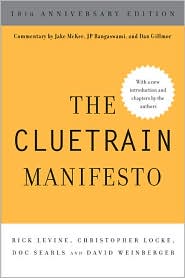
Cluetrain 10th Anniversary edition
Cluetrain 10th Anniversary
Everything Is Miscellaneous
Small Pieces cover
Small Pieces Loosely Joined
Cluetrain cover
Cluetrain Manifesto
My face
Speaker info
Who am I? (Blog Disclosure Form) Copy this link as RSS address Atom Feed

March 21, 2003

Groups! Help!

At the O’Reilly conference on emerging technology I agreed to talk about “the future of groups.” How the hell would I know? So, I’m turning to you. I just want enough to stimulate a discussion, so all I need from you is 20 minutes worth of brilliant insights that are staggeringly fresh, indisputable, and vastly amusing.

Here are the sorts of things I’ve been thinking about:

The Eskimos may have 35 words for snow (they don’t, and they’re not called Eskmos any more), but we have 100 words for groups. (Note, we also have 100 words for dirt.) But we don’t have good words for what we do online together. This is part of a general trend: as computing enters new phases, it takes over old words and stretches them beyond recognition: information, documents, and now communities. It’s actually the concepts that are being stretched, of course.

Groups vs. groupings. A grouping is a set of people who are unknowingly lumped together for some third party’s purpose: a demographic is a grouping. A group consist of people who have clustered themselves. The Internet gives dominance to groups over groupings.

Why the word “community” is wrong for most of what’s on the Net. A community is a group of people who care about one another more than they have to. That certainly occurs on the Net, but not always. In fact, the ease of virtual group-forming means that there are many more ecological niches that are being filled in the social ecology. E.g., membership in RW groups used to be required because of problems scaling meetings; now membership often plays a different role, if it’s required at all. Maybe do a 3-D matrix and suggest unfilled niches. (If that doesn’t work, maybe show “The Matrix” in 3D.)

Groups are at the heart of the Internet’s value. (See Reed’s Law vs. Mecalfe’s Law.) Yet the Internet doesn’t look like groups, with a few exceptions (mailing lists, buddy lists). Myopia rules. I can’t see the web of people who whom I’ve sent out email. We can’t even do anything with the rich social web created by second degree buddy lists. What would the Internet look like if we looked at it from the group point of view? Answer: I dunno.

Why hasn’t word of mouth done even better on the Net? We have generalized sites (epinions, Amazon) but not among friends and not for geographic localities. (Note: I’ve started failed businesses to address these so-called opportunities.)

I don’t want to look like a moron in front of an audience of my betters! Hellllllp!

Tweet
Follow me

Categories: Uncategorized Tagged with: web Date: March 21st, 2003 dw

10 Comments »

Recommended Disagreements

Arnold Kling disagrees with me about anonymity.


Norman Mailer is back in form as a psycho-mytho-political commentator.


You tell me: Is this Web design firm’s home page the worst professionally designed Web site you’ve seen? Or do I just not appreciate de Modern Stijl?

Tweet
Follow me

Categories: misc Tagged with: misc Date: March 21st, 2003 dw

6 Comments »

March 20, 2003

Refocusing Peace

Grant Henninger is suggesting that the peace movement refocus its message since obviously we’re not going to prevent the war. Instead, Grant suggests, we should focus on limiting civilian casualties and ensuring that we step up to our responsibility to rebuild Iraq afterwards.

I’m in favor of both of Grant’s points, but I think there is a point to continuing to protest the war itself: It tells the government that we don’t all fall into a line when a war is declared, and it tells the world that not all Americans believe this war is worth the death and instability it will bring.

Nevertheless, I think Grant raises a point worth discussing.

Tweet
Follow me

Categories: Uncategorized Tagged with: politics Date: March 20th, 2003 dw

Be the first to comment »

After the War

When I was 12, I remember listening in my bedroom for sirens to tell me that soon I’d be inhaling the radiated dust that once was New York City 15 miles away. The US Navy was going to intercept Russian ships suspected of transporting nuclear missiles to Cuba. The Russians would either allow us to board or they would fight back, likely escalating quickly into a “nuclear exchange.”

The Russians “blinked.” Kruschev didn’t have JFK’s balls. (The fact that we actually did a deal with him — we agreed to remove our missiles from Turkey on his border — didn’t emerge until years later.)

We won and we learned the wrong lessons. We are going to win in Iraq and we will also learn the wrong lessons.

The Cuban Missile Crisis was only a crisis because we made it one. Having nuclear missiles in Cuba did not affect our national security one iota. Soviet subs armed with nuclear missiles patrolled our shores, so why did it matter that there were a handful more nukes 90 miles away? The presence of Cuban missiles only meant that Miami might be vaporized 8 minutes sooner than New York. The deterrent to any attack remained the 28,000 nuclear weapons we had dispersed around the world.

The Cuban missile crisis was our fault. It was reckless. It was machismo that put the world at risk. Thank God Kruschev didn’t have JFK’s balls. In fact, the Cuban missile crisis is the best argument in history against balls.

But, we learned from it that playing chicken “works.” We learned that threatening to end life on the planet is an effective way of getting what you want. We escalated the arms race — it was JFK, after all, who campaigned by making up a “missile gap” — to heights that almost bankrupted us before it bankrupted the Soviet Union. The real lesson should have been, IMO, that nuclear weapons are too dangerous to use except for deterrence. And if deterrence was our goal, we only needed a few subs swimming deep under water.

Now we are going to win another fight; we would turn the desert to glass before we would lose. And the lesson we’ll draw from this is that it’s honorable to be willing to wage war alone, that war works, that the UN doesn’t, that we are not secure unless every risk is removed, that peace means no strife or disagreement, that strength means power and that restraining from the use of violence is weakness.

Each of these lessons is wrong. The world will be more dangerous because of it.

And there’s not a thing we can do about it. It’d be like suggesting that the Cuban Missile Crisis wasn’t really an American triumph at all.

Tweet
Follow me

Categories: Uncategorized Tagged with: politics Date: March 20th, 2003 dw

6 Comments »

Peace Swarm

Here’s a little experiment in social software.

I’ve been talking with Jack Bury, a 20-year-old American poet living in Amsterdam, who is part of a tiny start-up trying to get some traction for “Eyebees,” a Microsoft IE add-in. (It’ll be open sourced eventually.) The add-in puts a frame on the left of your browser that shows you up to 200 little dots (Eyebees), each representing another person in the “swarm” you’ve joined. Their relative position shows which pages they’re currently viewing. If a few people are each looking at, say, Doc’s blog, then you’ll see the five Eyebees clustered together; clicking on any of them loads the page they’re looking at. You can also send a message to any of the Eyebees visible in the panel. Cool idea.

So, Jack is proposing that at noon EST tomorrow (Friday), we do a “peace swarm,” i.e., a bunch of people who are sorry about the war we’ve started will all click on the appropriately-named swarm at www.eyebees.com and we’ll browse around together. So, if you wanna hang out for a bit tomorrow, download the software and join the swarm.

And now for the main question this raises to me: Why can’t I be a 20-year-old poet living in Amsterdam? Please?

Tweet
Follow me

Categories: Uncategorized Tagged with: web Date: March 20th, 2003 dw

6 Comments »

This just in …

Breaking News
Save Over 40% on Intel CPUs!

Look, TigerDirect, you’re a fine discounter, but please don’t send me any more email with “Breaking News” in the subject unless there’s some actual goddamn news in it like a cure for ebola, Ireland rotating 15 degrees clockwise, or President Bush’s succubus emerging and announcing that it’s worn out and is taking a few days off.

Tweet
Follow me

Categories: Uncategorized Tagged with: humor Date: March 20th, 2003 dw

1 Comment »

Iraqi Blog

This blog from Baghdad is must-read for two reasons. First, it will tell you more about what the coming war feels like than 24 hours of network babble. Second, it is a vivid example of why blogging matters.

(Thanks to Kathy Quirk for the link.)

Tweet
Follow me

Categories: Uncategorized Tagged with: politics Date: March 20th, 2003 dw

4 Comments »

March 19, 2003

Buy a Dixie Chicks Album for Freedom

The Dixie Chicks’ album is plummeting because they are being kept off the air for saying what many of us feel. I myself am about to buy muh very first Dixie Chicks CD.

You can get their new one, Home, for $14.00 plus shipping at their web site.

Tweet
Follow me

Categories: Uncategorized Tagged with: politics Date: March 19th, 2003 dw

214 Comments »

Democracy is a conversation

From William Du Bois, from a mailing list I’m on:

Bush’s Utopian Plan for Peace and mine differ at the core.

Hal Pepinsky, one of the founders of peacemaking criminology, talks about the dynamics of democracy and violence.

He defines democracy as responsiveness — we take each other into account. We may not change our agenda but we take what the Other has to say into account. Violence is the opposite of democracy. It is asserting your own will and refusing to take the other into account…

Tweet
Follow me

Categories: Uncategorized Tagged with: politics Date: March 19th, 2003 dw

4 Comments »

Equity, Ambivalence, and Bombing for Peace

You know how the NY Times wrote a few hundred words about each and every person who died in the attack on the World Trade Center? Suppose the Times were to accord each Iraqi civilian we kill the same dignity. Of course the Iraqi victims will be unintended casualties, unlike those who died on 9/11. But, they are predictable unintended casualities, so why not remind us of the price of victory? Why not remind us that an Iraqi father searching for his child in the rubble is no different from my friend who waited for a phone call from his son who worked in the Towers? Are Iraqi lives really not worth the ink? Or our attention?

Wouldn’t such coverage help tell the world what sort of people we Americans are?


The bumpersticker “Bombing for peace is like fucking for virginity” pisses me off because it glosses over the hard question: Is this particular war worth fighting? Will it create a more peaceful world once the bombs stop turning people into red mist? That’s the difficult discussion we need to be having. My answer is: No! But not because bombing is always illogical the way fucking for virginity is always self-contradictory. I’m not a pacifist, so I think sometimes bombing makes sense. Our challenge is to figure out when. This bumpersticker doesn’t help.


Here is my new bumpersticker. I’m not satisfied with the wording, though. Any suggestions?

Moral means  ambivalent - D. Weinberger - non-commercial use permitted

Tweet
Follow me

Categories: Uncategorized Tagged with: politics Date: March 19th, 2003 dw

19 Comments »

« Previous Page | Next Page »


Creative Commons License
This work is licensed under a Creative Commons Attribution-NonCommercial-ShareAlike 3.0 Unported License.
TL;DR: Share this post freely, but attribute it to me (name (David Weinberger) and link to it), and don't use it commercially without my permission.

Joho the Blog uses WordPress blogging software.
Thank you, WordPress!