


logo
EverydayChaos
Everyday Chaos
Too Big to Know
Too Big to Know
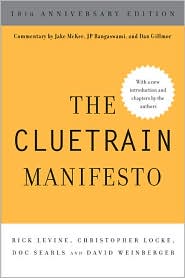
Cluetrain 10th Anniversary edition
Cluetrain 10th Anniversary
Everything Is Miscellaneous
Small Pieces cover
Small Pieces Loosely Joined
Cluetrain cover
Cluetrain Manifesto
My face
Speaker info
Who am I? (Blog Disclosure Form) Copy this link as RSS address Atom Feed

March 3, 2003

DigId Again…

Eric does a good job anticipating my replies to his replies about digitalID.

The people I trust who know about such things (including Eric) agree that the Liberty Spec will give users fine-grained control over their identity information. Many of the supporters of it like it precisely because it gives customers a shield against the commercial interests that are without conscience or soul. Having said that, however:

Adopting the Liberty Spec gives users a technical means to protect their ID but simultaneously and in exactly the same way creates the infrastructure by which ID information can be demanded and delivered. So, the defense is via technology but the demand is via economic forces. Guess which will win?

Tweet
Follow me

Categories: Uncategorized Tagged with: uncat Date: March 3rd, 2003 dw

4 Comments »

Fighting to Stay Anonymous

Eric has been blogging away about his useful Perry Barlow Paradox. I’ve been avoiding commenting because I’ve been too swamped with small, profitless alligators to give the topic the thought it deserves.

So I’m giving up on thinking and plunging in instead.

First, is John Perry Barlow’s last name Perry Barlow or Barlow?

Second, Eric’s Paradox seems to me to be generally right and a great way of putting something important: “The internet, in its current form, moves everything that touches it toward the public domain.” This is true the way “Information wants to be free” is true: Often, but not always. And it’s true the way the law of gravity is true: We can still jump and walk uphill.

Eric has used the Paradox to knock my notion that we have a default right to anonymity on the Internet. I replied with an elaboration of where I think the right comes from. Eric apparently is unconvinced.

I am likewise unconvinced that agreeing with the Perry Barlow Paradox, means giving up the struggle to preserve our anonymity on the Internet. The fact that things tend towards the public domain on the Internet doesn’t mean that it’s good for everything to be in the public domain. Nor does it mean that everything inevitably has to be in the public domain.

Doc has taken up the cudgels and I love everything he says in his blog entry except his conclusion. DigitalID is not going to empower consumers so that we actually become customers again. The Big Boys want it because they see that even if the customers are in nominal control of their own IDs, the economic power is so unevenly weighted that we will have to give up our ID info in order to engage with them. It seems to me that anonymity is a much more powerful weapon against the predations of corporatism.

DigitalID is forking the Internet into private and public spheres. We should be so unhappy about this that we fight against it, not declare it to be a law as inviolable as those of physics. Norlin’s admirable Perry Barlow Paradox should be a clarion call, not Taps.

Tweet
Follow me

Categories: Uncategorized Tagged with: web Date: March 3rd, 2003 dw

1 Comment »

More You First

From Phillip Wolff comes these comments on my You First idea, a pledge by a site that it will respect our anonymity:

I’m drafting a version of this for job boards. It’s a job board’s business to share your information (resumes, CVs, profiles) with employers and employment agencies. This complicates things enormously.

Potential additions to your pledge:

– Transparency/FOIA. If it’s about you, you can see it when you want. We will share with you all the information we hold that describes you or is associated with your identity. This includes data provided by others.

– Two-Degrees Exposed. We’ll keep a list of those people/accounts/organizations that called up your information. You can see the list.

– Three-Degrees Transitive. Here are the policies agreed to by those third parties (employers, headhunters, et al) who call up your information as our customers. May be less stringent than our policies.

– Sunset. We will expire our copies of information about you according to rules we’ll publish. Old data won’t haunt you.

– Amnesia on demand. If you want us to purge our databases of information about you, we will, subject to legal obligations.

– Bind successors. If we sell off the business or a part of it, we’ll shred your data or force the new owners to abide by all this. See opt-in.

– Civil Rights. While we will cooperate with law enforcement, we won’t ebay your information. Our policies will defend your information like it was our own, requiring court orders or other lawful compulsion to turn over your data.

Excellent! Thanks, Phil.

Tweet
Follow me

Categories: Uncategorized Tagged with: web Date: March 3rd, 2003 dw

Be the first to comment »

Future Look

Mike O’Dell sends us to a site with images from the past of what our present (= their future) might look like. Very cool.

Tweet
Follow me

Categories: misc Tagged with: misc Date: March 3rd, 2003 dw

Be the first to comment »

March 2, 2003

The Right to Anonymity

Eric Norlin notices my casual mention of “our right to maximum anonymity” and writes to ask where exactly this right comes from.

Unfair! If I had known someone was going to take what I wrote seriously, I wouldn’t have written it. Nevertheless, here’s a rearguard attempt to justify, explain or evade what I meant:

I’m not claiming that the right to anonymity is a legal right. As far as I know, no court has recognized such a right. But not all rights come from law. For example, most of us feel comfortable saying that Afghan women under the Taliban had a right to be educated even though they had no such legal right. The Right to Lifers assert a right for fetuses that the legal system hasn’t recognized. And the parents of the American Revolution certainly were asserting rights not recognized by law.

But what is a right? It’s the other side of a duty. If I have a right to not be X’ed, you have a duty not to X me. Rights generally are not absolute if only because they sometimes conflict. For example, your right to privacy (a legal right in the US) can be overridden if the police have reason to investigate you, or if John Ashcroft doesn’t like the way you look.

Rights only emerge when we need others to perform duties. For example, we may have always had a right to clean air, but it only emerged as a right worth mentioning once our air got fouled. The emergence of a right can make explicit what had been an inconspicuous, default state.

That’s how I see the right to anonymity. It’s been the default on the Internet. A world in which that default is maintained is a better world than one in which our every click is tracked, our every purchase becomes a datum to be turned against us, our every download is assumed to be shoplifting. The putative right to anonymity is based (very loosely) on a facet of social life: we are an individualistic society that has to give me a reason before it can demand anything of me, including knowledge about me. Anonymity has been and should be the default.

Constitutional Amendment anyone?

Tweet
Follow me

Categories: Uncategorized Tagged with: web Date: March 2nd, 2003 dw

6 Comments »

Tom Stewart on the Net Revolultion

[Written on Friday…]

Tom Stewart — the intellectual capital guy and editor of HBR — is giving the keynote at the DigitalNow conference. He says that although the Internet bubble has burst, the Net has indeed changed everything. He backs it up with examples from the business mainstream. Cool.

Tom points to four transformations:

1. Speed. We can buy whenever we want. We can communicate whenever we want. A faster economy challenges executives who have to make faster decisions.

2. “There’s no commerce like ecommerce.” E.g., Wyeth is saving 25% by buying electronically.

3. King Customer. A substantial shift in power from sellers to buyers largely because of the Internet.

4. Loosely Coupled organization. (This is what I call The Hyperlinked Organization.) The line between inside and outside is no longer clear. E.g., 90% oF products with Cisco’s name on it have never been touched by someone whose paycheck comes from Cisco.

The audience — heads of associations — absolutely needed to hear this message and responded to it enthusiastically.

Tweet
Follow me

Categories: Uncategorized Tagged with: web Date: March 2nd, 2003 dw

Be the first to comment »

Reading the Circulars the Day before the War

Buy One at 6.99 Get one FREE
Dawn or Charmin’ 88¢ Your choice

Change the World With a New
Wireless Phone/Camera Combo

Next-Generation
Wireless Phone With
Full-Color Display

Shoot now,
print now
with digital imaging from HP

Spring is just around the corner —
so is RadioShack!

FusionAVTM cables
unleash the full potential
of your audio and video!

Procter & Gamble will donate 10¢ to Special Olympics
each time you buy one of these supporting products!

Arm ¢ Hammer
Laundry Detergent, 100 oz

Celebrate Family
Eye Health Month.
50% off a complete pair

Simply White
Even Easier Whitening
Just Apply and Go

It’s your roll to voteTM
for the New 5 Flavors
Vote now at
Candystand.com

Pop, Peek and Win!
with ACT II Microwave Popcorn!

If you’re serious about
keeping your bones healthy…
“Don’t take chances.
Take OSCAL”.

You’ll see stars when you get hit
by our low prices

Kids Won’t Skip the
Breakfast They Dip!

When Tough Stains
Can’t Be Removed.
Get Spot Shot.

Pine Kneewall Chest
Build-em In
Top quality Pine
Rough cut opening
Today Is Savings Day

Grab the remote and hold on!
Mitsubishi digital projection TVs

6 Months No Payments, No Interest*

Tweet
Follow me

Categories: misc Tagged with: misc Date: March 2nd, 2003 dw

Be the first to comment »

March 1, 2003

Making the World Safe for Slightly Different Opinions

A USA Today survey shows that 87% of Americans say that nothing any celebrity could say would change their mind about the Iraqi war. Good!

But that hardly means that celebrity protests make no difference. Even if they change no minds, they help legitimize the anti-war position. So, keep it up Sean, Martin, Tyne, Anjelica and every uni-named star who speaks her mind.

Tweet
Follow me

Categories: Uncategorized Tagged with: politics Date: March 1st, 2003 dw

Be the first to comment »

Letter from an Heroic Diplomat

John Brady Kiesling, a US diplomat with twenty years of service, has resigned because “the Bush administration has squandered U.S. legitimacy through a ‘swaggering and contemptuous’ approach to foreign policy.” (Salon)

Tweet
Follow me

Categories: Uncategorized Tagged with: politics Date: March 1st, 2003 dw

Be the first to comment »

Pseudonymity

Norlin has a good explanation, based on Bryan’s explanation, of how the Liberty Alliance spec handles account linking. There’s a comforting indirectness about it.

Tweet
Follow me

Categories: Uncategorized Tagged with: web Date: March 1st, 2003 dw

2 Comments »

« Previous Page | Next Page »


Creative Commons License
This work is licensed under a Creative Commons Attribution-NonCommercial-ShareAlike 3.0 Unported License.
TL;DR: Share this post freely, but attribute it to me (name (David Weinberger) and link to it), and don't use it commercially without my permission.

Joho the Blog uses WordPress blogging software.
Thank you, WordPress!