

logo
EverydayChaos
Everyday Chaos
Too Big to Know
Too Big to Know
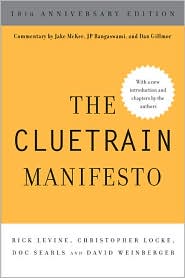
Cluetrain 10th Anniversary edition
Cluetrain 10th Anniversary
Everything Is Miscellaneous
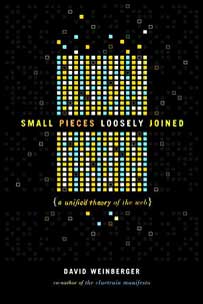
Small Pieces cover
Small Pieces Loosely Joined
Cluetrain cover
Cluetrain Manifesto
My face
Speaker info
Who am I? (Blog Disclosure Form) Copy this link as RSS address Atom Feed

January 20, 2003

Richard Rorty

Norm Jenson responds to my blogged outline of the class I’m doing at MIT. He recommendsd an article by Richard Rorty, “The Decline of Redemptive Truth and the Rise of a Literary Culture.” Rorty is one of the few practicing philosophers who makes me wish that I had actually kept reading philosophy during The Great Forgetting (= the 17 years since I left academics). Rorty’s pragmatism is itself highly pragmatic and not lost in theories of pragmatism. He revels in how he has dodged the 16-ton weight that philosophy has shouldered for millennia. His thought is actually frolicsome. For example, on his home page you’ll find a link to “Redemption from Egotism” where he writes:

The emergence of the novel has contributed to a growing conviction among the intellectuals that when we think about the effects of our actions on other human beings we can simply ignore a lot of questions that our ancestors traditionally thought relevant. These include Euthyphro’s question about whether our actions are pleasing to the gods, Plato’s question about whether they are dictated by a clear vision of the Good, and Kant’s question about whether their maxims can be universalized. Instead, a decision about what to do should be determined by as rich and full a knowledge of other people as possible—in particular, knowledge of their own descriptions of their actions and of themselves. Our actions can be justified only when we are able to see how these actions look from the points of view of all those affected by them.

Seen in this light, what novels do for us is to let us know how people quite unlike ourselves think of themselves, how they contrive to put actions that appall us in a good light, how they give their lives meaning. The problem of how to live our own lives then becomes a problem of how to balance our needs against theirs, and their self-descriptions against ours. To have a more educated, developed and sophisticated moral outlook is to be able to grasp more of these needs, and to understand more of these self-descriptions.

Damn, that’s good. And, placed in the context of thousands of years of philosophy aimed at deducing morality from principles or calculating it based on totally pleasures and pains, it’s radical. (It also says clearly what I’ve been struggling to say aboutsympathy-based morality.)


From Vergil Iliescu comes a link to a BBC lectures on trust and digital identity. For example, Tom Bailey writes a philosophical history of trust (Glaucon, Machiavelli, Hobbes, Hume) that’s clear and engaging, and works itself around (in its philosophical way) to saying that the traditional pessimists think trust is irrational because they have forgotten that first and foremost humans are social. I’m not satisfied with Bailey’s resolving sociality into individuals taking responsibility for the parts they play in our lives, but the article remains highly readable and readworthy.

Tweet
Follow me

Categories: Uncategorized Tagged with: philosophy Date: January 20th, 2003 dw

9 Comments »

January 19, 2003

MIT Session #3: The Web and Reality

I’m teaching the third and final session of my mini-course at MIT on Tuesday, 7-9, building 1, room 390. The session is modestly titled: “Our World — The Reality of Connections”

Here’s an outline of what I think I’ll be saying during the Me Speak portion of the session. I’d appreciate it if you’d kick the bejeezus out of it before I present it. Thanks.


What makes the real world real?

It’s persistent.

It’s (roughly) the same for all of us.

It’s where the matter is. (But what makes matter interesting is that it’s persistent and the same for all of us)

Why are these marks of reality? Real = what exists independently of us.

From this comes an awfully lot:

The valuing of facts, knowledge as knowledge of facts, objectivity as the mood of facts.

How do we know that which is independent of us? Create an inner representation.

Then how can we know anything? Certainty grows as the mark of knowledge.

This view is deeply alienating:

We are alone in our own minds, each with our own inner representation of the external, real world.

Can’t ever really see what’s real – stuck with what our head can hold.

Separates meaning and being. What is is essentially devoid of meaning, while what something is as is dependent on how we take it and thus is essentially unreal.

But is the real world really like that?

Individuality is secondary: we can only be individuals because we are born into a social order, language, etc.

Science works and it has priority if your project is to see how the world works without our involvement, but that is only one valuable project.

The real world is ambiguous and continuous. The inaccuracy of our measurements is not due to the failing of our instruments.

And we lose much in being objective (yadda yadda).

Now let’s talk about the Web.

What happens to knowledge on the Web? Becomes voiced, situated, based on care.

What happens to individuality on the Web? Becomes social.

What happens to meaning on the Web? Meaning is the matter of the Web.

So, the Web fails the test of reality as what exists independent of us, and as the residue after meaning has been withheld. But that sense of reality is corrupt and alienating. The Web’s realness has to do with connection, meaning and passion…just what our alienated view of reality in the RW lacks.

No wonder the Web feels familiar and important.

Tweet
Follow me

Categories: Uncategorized Tagged with: philosophy Date: January 19th, 2003 dw

20 Comments »

Open Spectrum FAQ

I’ve put together a FAQ on Open Spectrum, based on ideas and info from Dwayne Hendricks, David P. Reed, and Jock Gill. It complements a paper on Open Spectrum the four of us collaborated on also. The Open Spectrum FAQ is a further attempt to explain the issues in a way that non-techies can understand. (In fact, my chief role on the project was to keep saying “Huh?”) So, I hope you’ll read it, suggest changes and additions, and link to it.

Open Spectrum is a big issue we need to get on the table now because piecemeal solutions — some attractive in their own right — are being put forward. This is our chance.
(Thanks for Greater Democracy for hosting it.)

Tweet
Follow me

Categories: Uncategorized Tagged with: tech Date: January 19th, 2003 dw

4 Comments »

January 18, 2003

Dream Tags

Last night I had an honest-to-Pete dream about an addition to the HTML spec. Yes, I dreamed that hyperlinks had ALT metadata. You could have a tag like:

<a href=”http://www.somewhere.com/page.html” ALT=”Archived version of article”>

If you hover over a link, you’re shown the ALT text, just as when you hover over an image. This would be occasionally useful when you don’t want to muck up your text with metadata (e.g., you want to have a link that just says “Next”) and might enable some apps to do interesting things with the metadata. It’d be especially useful as a “tool tip” when you’re walking through a process (e.g., a “Go” button that tells you “Pressing this will submit the name you just entered and will take you to the next step where you’ll press your butt against the scanner”).

I am 100% confident that this idea either exists or was rejected for good reasons; you can already use REL to specify the relationship between the link and the target and TYPE to state the nature of the target, but browsers don’t treat these like ALT tags. Anyway, I was merely a vehicle for this dream and am not responsible if the ideas contained within are old, stupid or stolen.

So, what do you make of that, Dr. Freud?

Tweet
Follow me

Categories: Uncategorized Tagged with: web Date: January 18th, 2003 dw

8 Comments »

January 17, 2003

How Many Wifis could a Wifier Wifi if a Wifier could Wifi Wifi?

I’m trying to get a ballpark estimate of how many wifi-ers there are in the US and worldwide. I’d be happy just to know how many wifi cards have been sold. But in researching this (i.e., looking it up on Google), I came across a seeming discrepancy in numbers. According to an article by Adam Baer called “The Wif-Fi Boom“:

William Clark, research director at Gartner, said that the number of frequent Wi-Fi users was expected to grow to 1.9 million next year from 700,000 in 2002, with the number of public hotspots in North America likely to nearly triple by the end of next year from about 3,300 now.

But an article by journalist and friend Glenn Fleishman, called “So Many Nodes, So Little Security,” says that a recent study show found “14,000 business and personal networks ” in NYC alone.

What’s amusing is that these two articles appeared in the same issue of the “Circuits” section of The New York Times.

My money’s definitely on Glenn. If you have any other figures for the number of wifi-ers, please let me know; I’m doing a segment on wifi for the radio show “Here and Now” and I’d like to be right within an order of magnitude.

Tweet
Follow me

Categories: Uncategorized Tagged with: web Date: January 17th, 2003 dw

5 Comments »

Some Reasons Not to Totally Despair about Copyright

A for-pay article on Salon — jeez, I wish they’d keep in the for-free side of the ledger articles so clearly in the public interest — tells us not to give up the copyright battle yet. Siva Vaidhyanathan writes:

While dismissing the notion that excessive copyright expansion has severe First Amendment implications, she [Ginzburg] invoked two of the classic democratic safeguards of American copyright: the idea/expression dichotomy and fair use. Because of these two concepts, Ginsburg concluded, the court need not take the censorious power of copyright seriously. …

In the wake of this decision, if Congress and later courts are going to take Ginsburg’s words seriously, they must take fair use and the idea/expression dichotomy seriously. They cannot take them for granted, as so many have in recent years.

In dismissing First Amendment concerns, Ginzburg wrote : “… when, as in this case, Congress has not altered the traditional contours of copyright protection, further First Amendment scrutiny is unnecessary.” This, the article says, may give us a hook on which to hang an argument against the DMCA since it ploughs right over those traditional contours.

Further, the article says that this decision moves the issue from the courts back to Congress where the will of the people has a small shot at being heard: when Larry “Bless His Heart” Lessig and Eldred began this case four years ago “they had no army of CD burners and TiVo users behind them.”

(That’s why I’m so happy someone gave Michael Powell a TiVo. Now could someone please give him a DeCSS decrypter, some Cuban cigars, and a baggie of really great grass?)

Tweet
Follow me

Categories: Uncategorized Tagged with: politics Date: January 17th, 2003 dw

1 Comment »

January 16, 2003

Internet=Truth. Web=Morality.

[Too long. Not long enough. Too loosely joined. Thoughts-in-progress.]

The class session at MIT went better this time than last time, I thought. In part that’s because I’m finding my sea legs. In part it’s because I presented a more structured and coherent set of ideas than last time. I think I got clearer to myself about what I mean. So, here’s a stab at further shaping what I said, minus the masturbation joke and the True Tale of Keanu contributed by one of the attendees.

The mystery of morality for philosophers has been why individuals do what’s right even when it seems not to be in their own self-interest. What makes an action moral? What makes an “ought” statement morally compelling?

Look at how philosophers decide what makes something moral. E.g., utillitarianism says that X is moral if it increases the sum of pleasure. But as soon as John Stuart Mill proposed that, he had to distinguish lower and higher pleasures to counter the objection that gluttony brings a lot of pleasure. Or, suppose there’s some case where killing an innocent child would result in much more overall pleasure than pain . We’d better come up with a variation of utilitarianism that’d save the kid. But why? Because we already know that a rule that says eating all day, taking breaks only to kill innocent children, is wrong. We test our moral theories by seeing if they sort our moral “intuitions” correctly.

Of course there are terrible problems with basing a moral philosophy on intuitions, since Nazis and terrorists have very strong intuitions. But let’s ask a slightly different question: What makes humans capable of being moral, of understanding events morally?

This only looks like a challenging issue because western philosophy generally (even broader strokes a-comin’!) has made two assumptions: It begins with individuals as the atoms and it begins with consciousness as our basic form of awareness. Phenomenology contradicts the second idea, however, and uses it to contradict the first. It says that consciousness is always conscious of something — it’s always filled with the world — and, most important, it is not a detached form of knowing or perceiving. We’re not just aware of our world, we care about it. We care about it because we know we’re finite, vulnerable, mortal. Within the world we care about are some special “things”: other people. We understand from the beginning — because our understanding is mediated through language, the most profound social invention — that we share this world with other people who are likewise caringly absorbed in the world.

How is our shared caring expressed? Through sympathy. But I don’t mean that I feel the same emotions as you, as if we had internal tuning forks. I mean that you and I are capable of caring about the world in the same way. In sympathy we can show each other the world as it appears to us and let the see how we care about it.

Because our existence in the world is a shared caring, selflessness both marks much of morality and forms the initial moral puzzle of why we sometimes act against our own interests: we sacrifice our interests for the sake of others on occasion not because it’s Moral with a capital M but because it recognizes the two basic truths: there are other people and we care about them. Sharing and caring. See, Mr. Rogers was right.

Very basic stuff, yet it runs contrary to the traditional picture of individual consciousnesses living in inner representations of the world, unable even to prove that the world and other people exist outside of our thoughts.

Now, why go through all the above folderol? Because the architecture of the Internet happens to match the phenomenological view of morality rather eerily. Here goes. And I’ll try to be brief.

In a nutshell: The Internet is about truth and the Web is about morality.

The Internet was created to move bits around without knowing anything about what the bits encode: porn bits look exactly like biblical bits. So, at its heart the Internet values a non-partisan, unfiltered exchange of information. It is decentralized. It is permission-free. But these are exactly the characteristics required for the pursuit of truth in a diverse world.

The Web, built on top of the Internet, brought us pages, browsers and links. Of these, links are the most important because without them you only have a set of disconnected pages, not a Web. The Web thus begins with connections, not individuals. This mirrors the human context in which morality is possible: we find ourselves first in a world we share. Connections come first. If you start with the individuals instead of our connection, you can never build up to a moral world. (That’s the true Is that yields no Ought.)

Further, on the Web and in life we share this world not primarily as a physical, brute geology but in sympathy: a shared caring. “Here’s the world I see, based on what I care about. Let’s talk. Let’s joke. Even let’s flame.”

Further further, the links that connect us on the Web are small acts of selflessness, deferring to what we share — the topic of discussion, perhaps — rather than to the primacy of our own place in the world. If every site were as “sticky” as business sites would like to be, there would be no working Web.

The conclusion isn’t and couldn’t be that the Web is moral in the sense that everyone only does Good Things on it. Hah! Instead, I think the conclusion is that the Web’s architecture reflects our own moral natures. We can go as wrong on it as we can in the real world. But unlike the indifferent real world, the Web is based on an admission of shared caring, and thus has a tendency towards moral goodness just as our own moral natures do.


Clive Thompson, currently a Knight science-journalism fellow at MIT, has blogged the session. Asphodel, an MIT student, blogged the previous session under a title you gotta love: “I am profound! Hear me … whimper.”

Tweet
Follow me

Categories: Uncategorized Tagged with: philosophy Date: January 16th, 2003 dw

2 Comments »

Branding Us

Subscribers to AT&T broadband are having their email addresses switched for the third time in a year. Now they’ll be [email protected].

My guess is that there is no technical reason why the domain names are being switched. Rather, Comcast is using its customers as vehicles for its “brand. This is the clearest example I’ve seen of the confluence of the marketing and cattle farmer’s sense of “branding.”

Tweet
Follow me

Categories: Uncategorized Tagged with: uncat Date: January 16th, 2003 dw

3 Comments »

Larry Lessig">I heart Larry Lessig

I will work for him when he runs for Senate and then I’ll vote for him when he runs for president.

Tweet
Follow me

Categories: Uncategorized Tagged with: politics Date: January 16th, 2003 dw

1 Comment »

January 15, 2003

The Comedy of the Commons

Is free speech a commons?

Tweet
Follow me

Categories: misc Tagged with: misc Date: January 15th, 2003 dw

1 Comment »

« Previous Page | Next Page »


Creative Commons License
This work is licensed under a Creative Commons Attribution-NonCommercial-ShareAlike 3.0 Unported License.
TL;DR: Share this post freely, but attribute it to me (name (David Weinberger) and link to it), and don't use it commercially without my permission.

Joho the Blog uses WordPress blogging software.
Thank you, WordPress!