


logo
EverydayChaos
Everyday Chaos
Too Big to Know
Too Big to Know
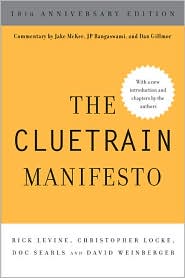
Cluetrain 10th Anniversary edition
Cluetrain 10th Anniversary
Everything Is Miscellaneous
Small Pieces cover
Small Pieces Loosely Joined
Cluetrain cover
Cluetrain Manifesto
My face
Speaker info
Who am I? (Blog Disclosure Form) Copy this link as RSS address Atom Feed

November 14, 2002

Why Spam Doesn’t Work

Masha Geller of MediaPost thinks she’s figured out why response rates to spam — um, “email marketing — are so low:

Email marketing company Silverpop yesterday released the preliminary findings of a study they conducted on response rates to permission email and found that one of the most overlooked causes of reduced response rates is “broken” or unreadable HTML. …

Here are some other reasons that occurred to me in just the last 24 hours:

If I had some domain names to register, I’d rather use .COM or .NET than .US or .NAME or .OBSCURE or whatever it is that you’re selling

The cheapest airline tickets are likely to have restrictions I wouldn’t like, even if they are totally guaranteed

Spying on my neighbor’s hot teenage daughter or on our babysitter would be just plain sick

I can’t fire my boss because, well, it just doesn’t work that way

I have more than enough printer ink for now

I haven’really been much interested in farm animals since I was 5 or 6, so I’m not going to go to your web site to look at photos

I don’t believe I can grow rich without doing anything of value

I don’t know what HGH is and I think I don’t care

While I’m flattered that you are impressed by my financial standing, I have more credit cards than I use

I read Nabokov’s Lolita and was quite disturbed by it, so I’m not interested in having Lolitas delivered to my inbox

Yes, my teeth are yellowing (how did you know??), but I’ll check with my dentist instead of buying whitener over the Net

I’m fortunate in not needing a debt reduction program

My wife’s not complaining

Nope, I still don’t need any HGH

I’m an animal rights type of guy so I don’t want a leather coat

Thanks for noticing that I am rather sexy, but sex with women less than half my age isn’t really all that appealing. Besides, if you can see that my teeth are yellow, why can’t you see the ring on my finger?

I’m not interested in toner cartridges that don’t come with HGH, whatever that is

I would have helped you get your money out of Nigeria, but how can I trust an email that doesn’t properly close all of its HTML tags?

Tweet
Follow me

Categories: Uncategorized Tagged with: uncat Date: November 14th, 2002 dw

1 Comment »

November 13, 2002

Quotable Panel

Last night’s panel discussion at the Jewish Technology Business Network turned out well. This is remarkable not because of the caliber of the panelists (Larry Weber, Chris Meyer, Cliff Conneighton) but because we didn’t have a topic. Moderator Scott Kirsner (columnist for the Boston Globe, contributing editor to Wired and Fast Company) did an excellent job of pulling the discussion together. The audience seemed happy.

Beforehand Chris Meyer said that Arthur Miller (the lawyer and moderator, not the playwright and Monroe husband) once told him that there are only two rules for a good panel discussion: Have fun, and no dead air.

Chris, in the course of the evening, had some quotable quotes:

“As they say in the AI industry, as soon as something works, it’s not AI any more.”

“No one has ever seen a bubble from the inside” — Lester Thurow

He also asked the audience whether the “mass of the US economy” has increased or decreased in the past century. And he meant literally how much the goods weigh. His point was that it’s decreased because we’ve miniatured and strengthened, and that’s going to happen again, radically, as nanotech emerges.

Finally, Larry Weber said that TV viewership is at an all-time low. Interesting.

Tweet
Follow me

Categories: Uncategorized Tagged with: uncat Date: November 13th, 2002 dw

Be the first to comment »

Garrison Keillor on Fire

Garrison Keillor is flaming. As one of our culture’s best story tellers ever, and as someone who has trademarked a transparent gentleness and a genuine civility, this outburst is remarkable. It’s short on particulars because, as the end reveals, it comes not from offended reason but from a broken heart.

(Damn! It’s available only to Salon premium members. Pay Salon the money, will you? It’s an experiment that deserves to succeed.)

Tweet
Follow me

Categories: Uncategorized Tagged with: uncat Date: November 13th, 2002 dw

1 Comment »

USAToday Op-Ed

USAToday today runs an op-ed by David Isenberg and me about why the telcos ought to be allowed to “fail fast.” This is based on the letter to the FCC a few dozen of us signed a couple of weeks ago.

But USAToday introduced an error into it. Where we said that the telephone network “was not designed” to handle anything other than voice data, USAToday edited it to say that it “can’t handle” non-voice data. Not right. This makes us look like dopes to people who are smarter than I, although I don’t think it actually much effects our argument.

Tweet
Follow me

Categories: Uncategorized Tagged with: uncat Date: November 13th, 2002 dw

Be the first to comment »

November 12, 2002

Bush Binoculars

(Notice the lens caps.)

Bush looking through binoculars
“Help! Evil-doers have blinded me!”


Michael O’Connor Clarke of I Love Me, Vol. I, points out that Snopes says the above photo is a hoax. I say to Michael: Does exposing this fact make the world a better place? I think not.

Tweet
Follow me

Categories: Uncategorized Tagged with: uncat Date: November 12th, 2002 dw

78 Comments »

Among the Jews

I’m a panelist tonight at a meeting of the Jewish Technology of Boston Network (well, it’s something like that) along with Chris Meyer, Larry Weber and Scott Kirsner. I think it starts at 7:30 at Temple Betha Avodah in south Newton. I don’t know if you need to be a member, to be Jewish, to be Jewish technology or to have a Jewish member, but I’m looking forward to it.

Also, the syndicated radio program “Here and Now” is running a 4-minute interview with me at 12:20 EST. I’m talking about ebooks. They ran one a couple of weeks ago and I hope to be doing these fairly regularly.

Finally, USAToday apparently is running on Wednesday an op-ed that David Isenberg and I wrote.

Tweet
Follow me

Categories: Uncategorized Tagged with: uncat Date: November 12th, 2002 dw

3 Comments »

21st Century Education

The Boston Globe has an editorial today about the MCAS, the standardized test required to get a high school degree. It gives two examples. First,

West Roxbury teachers are becoming experts in the MCAS. They analyze the tests’ questions and students’ answers, looking for trends in what the tests ask and what errors students make.

Then they teach to those trends. Second, the editorial reports that the same school is fobbing students off onto computers, using a $1,667 piece of software called “Plato.”

To my amazement, the editorial isn’t using these two educational programs as examples of what’s wrong but of what’s right. This is giving students a “21st education at schools with 21st century resources.”

Gosh, torquing your entire math curriculum in order to have kids pass a test and plopping kids in front of instructional software is so 21st century. Heavens forfend that we should revert to teaching kids so that they learn to love learning, reducing class sizes so teachers can teach what each kid needs to learn.

That this comes from a generally liberal editorial board is all the more depressing.

Tweet
Follow me

Categories: Uncategorized Tagged with: uncat Date: November 12th, 2002 dw

Be the first to comment »

November 11, 2002

Grand Theft Auto and Moral Fiction

Why is it that I find the computer game BlackHawk Down reprehensible but I’m ok with Grand Theft Auto 3 (GTA3)? In BlackHawk Down, you’re a righteous American soldier fighting local warlords who are starving their own people. In GTA3, you’re a hoodlum who succeeds by randomly killing innocent pedestrians and taking their money. Also, you hijack cars, kill policemen, and blow stuff up. Why do I have my moral polarity reversed when it comes to these two games?

I watched Pulp Fiction again the other night. I don’t want it to be one of my favorite movies, but it is. There, too, the fact that we side with hit men is oddly liberating. Unlike movies like The Godfather, Goodfellas and The Sopranos where we’re responsibly reminded intermittently that the protagonists are capable of violence that separates them from us, Pulp Fiction is non-judgmental about its characters’ murderousness. It accomplishes a true suspension of moral belief. This isn’t used for any profound purpose — Tarrantino is no Dostoyevsky — but it does enable us to enter a world where the basic rules have been altered. It is the equivalent of science fiction, except instead of removing the law against time travel, the law against murder is removed. Call it “moral fiction.”

To be popular, GTA3 and Pulp Fiction had to be comedies. GTA3 even has its own radio stations playing parodies of various musical styles. (“Ah,” says the pretentious classical DJ, “that reminds me of the summer I spent reading Proust … in the original Italian.”) In suspending morality, they keep us so disconnected from the victims that we can laugh at what in real life would be horrific. If we were to connect with our victims, the morality would no longer be suspended; when Nicholson falls for the hitwoman who is to be his victim in Prizzi’s Honor, morality — sort of — comes back into play because the human connection is made. Not with GTA3 or Pulp Fiction. Both are unrelentingly disconnected.

In fact, the implicit disconnectedness is itself the source of humor: When in Pulp Fiction Travolta accidentally blows a kid’s head off in the back of the car, that it means nothing to him and Jackson except that they have a mess to clean up is funny. The suspension of morality is so obvious and so obviously a literary device that it has no more effect on my actual moral stance than watching Star Wars made me think I can levitate objects by channeling “The Force.”

I understand why parents are concerned about GTA3. And I understand why news magazines make a to-do about it: Show a 5-second snippet in which a player is shooting a cop and you’re guaranteed an 8 minute segment with outraged parents and indignant politicians. And I’m queasy enough about it that I don’t let my 11 year old son play GTA3 because I don’t know what “moral fiction” will feel like to him. But the truth is that I’m more concerned about heroic games like “Blackhawk Down” where the ultimate moral message is that being right puts one in a zone where everything is permitted. That to me is the most dangerous moral idea.


Salon reviews the new version of GTA. Salon says it’s art. I don’t know about that, but it sure sounds like it kicks fictitious ass.

Tweet
Follow me

Categories: Uncategorized Tagged with: uncat Date: November 11th, 2002 dw

1 Comment »

November 10, 2002

Information: Some Historical Factoids

I’m giving a talk to a library association this week and thought I’d talk a bit about the history of information. My point will be that the post-computer sense of information is utterly different from the old sense but the new sense is infecting our view of ourselves and our relation to the world.

Among the factoids:

1. I can’t find an instance of Herman Hollerith, inventor of the punch card, referring to the cards as encoding information. In his patent application he talks about recording “data”:

This method consists, essentially: first, in arranging a standard, template or index; second, recording for each individual, unit, person or thing the various statistical data, to be compiled, relating to such person, unit, individual or thing, by punching from or otherwise locating on sheets, strips or cards, index points…”

2. While I knew that Hollerith had been inspired by the way in which some looms were “programmed,” I didn’t know the following:

I was traveling in the West and I had a ticket with what I think was called a punch phonograph. . . the conductor . . . punched out a description of the individual, as light hair, dark eyes, large nose, etc. So you see, I only made a punch photograph of each person.

I like the way this ties holes in a card to the most personal and embodied of the “information” about us: how we look.

3. Dr. Johnson’s Dictionary (1755) defines “information” as follows (according to an interesting academic article by Rafael Capurro):

1. Intelligence given; instruction
2. Charge or accusation exhibited
3. The act of informing or actuation

“Information” at this point wasn’t something separable from the human conversational context.

4. The third definition points to the oldest sense of “information” as something more than what is known. Aristotle thought that the form of a thing impressed itself upon the potential which is the human mind and that is how we come to experience the world. “In-forming” was thus our most basic human relationship to the world, the way in which soul and body met the world itself. That’s a lot different than our abstract sense of information today.

5. There is no N in Hollerith. (Ack. Thanks, Adina.)

Capurro has another article, which I haven’t yet read, called “Hermeneutics and the Phenomenon of Information.” Here’s the abstract:

This paper deals with the perspective of interpretation theory or hermeneutics of the process of information storage and retrieval as it was conceived in the early eighties. Further developments in the information technology as well as a broad international discussion on the hermeneutic paradigm in the information field were added to the original paper from 1986. The main thesis concerns not only the interpretative nature of information-seeking processes but also the role of interpretation with regard to the fragmentation of knowledge. Information is the shape of knowledge at the end of modernity. On the basis of the existential turn of interpretation theory the role of pre-understanding is stressed not only with regard to the information retrieval processes but also to the specific worldly situation in which the inquirers are embedded.

Aw, what the hell, here’s a summary of sorts from the beginning of the article:

First, with regard to the abandonment of the primacy of scientific rationality, information is admitted to be fragmentary, to come in pieces. The fragmentation is two-fold: in reducing knowledge to pieces, the original contextuality disappears or becomes tacit. Knowledge becomes, literally, partial, dependent on prejudices or on the knower’s frame of reference. This relativity of knowledge to a changing horizon of interpretation also brings to the fore of epistemology a new category: that of truth as now, at the end of modernity, inseparable from that of relevance.

Second, with regard to the abandonment of the subjectivity-objectivity opposition, information is described as having a certain commonality. Information is something basically human which should be in principle accessible to everyone. Modern knowledge is something common, shared by a community, for instance by a scientific community.

Third, with regard to the abandonment of the idea that knowledge is something separate from the knower, there is the notion of mediation. Modern information technology disseminates all kinds of knowledge all the time to everyone in a way prefigured by printing. Information becomes part and parcel of media, becomes a medium.

Tweet
Follow me

Categories: Uncategorized Tagged with: uncat Date: November 10th, 2002 dw

2 Comments »

November 9, 2002

Googling Page Ranks

Art Medlar writes to a mailing list:

A friend points out that google’s raw ordering of pages by rank can be had by searching for “http”:

http://www.google.com/search?num=100&q=http

Cool!

Tweet
Follow me

Categories: Uncategorized Tagged with: uncat Date: November 9th, 2002 dw

Be the first to comment »

« Previous Page | Next Page »


Creative Commons License
This work is licensed under a Creative Commons Attribution-NonCommercial-ShareAlike 3.0 Unported License.
TL;DR: Share this post freely, but attribute it to me (name (David Weinberger) and link to it), and don't use it commercially without my permission.

Joho the Blog uses WordPress blogging software.
Thank you, WordPress!