
logo
EverydayChaos
Everyday Chaos
Too Big to Know
Too Big to Know
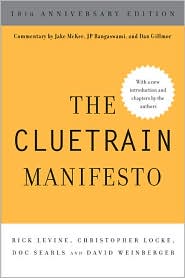
Cluetrain 10th Anniversary edition
Cluetrain 10th Anniversary
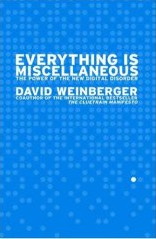
Everything Is Miscellaneous
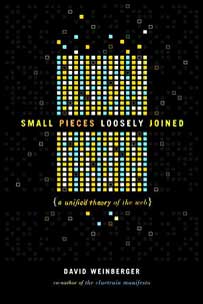
Small Pieces cover
Small Pieces Loosely Joined
Cluetrain cover
Cluetrain Manifesto
My face
Speaker info
Who am I? (Blog Disclosure Form) Copy this link as RSS address Atom Feed

October 13, 2002

Bryan Field-Elliot’s DIDW Recap

Bryan, CTO of PingID, has blogged his recap of DigitalID World. He captures it well. (PingID is a “member owned identity network,” the sort of ID system that privacy-obsessed webheads would create … and I mean this in the very best sense.)

I got to have a couple of beers and dinner with Bryan, a guy who’s smart and open and interesting and doing good in the world. It’s the type of semi-chance encounter that makes the real world fun on occasion. (Despite the nice things he says about me in his recap, it was useful to be reminded of what I said about digital IDs after two beers; I have no capacity for liquor and I’d forgotten. Surprisingly, I think I still agree with me!)

Tweet
Follow me

Categories: Uncategorized Tagged with: uncat Date: October 13th, 2002 dw

Be the first to comment »

SNL Sucks

From the Why Would I Care Dept.? comes news that I’ve posted a review of Saturday Night Live on Blogcritics.org.

Tweet
Follow me

Categories: Uncategorized Tagged with: uncat Date: October 13th, 2002 dw

Be the first to comment »

World’s Smartest Person Makes Error

Although I’m frankly afraid of Marilyn Vos Savant, the World’s Smartest Person, she is wrong in her column in Parade today.

Which of the following sentences is grammatically correct: “I ran over him with my car,” or “I ran him over with my car”?
-Lee McKimmons, Glendale, Ariz.

I hope you’re just writing a novel, Lee. Anyway: “I ran over him with my car” is correct. This is called an “active” construction. Also correct is: “He was run over by my car.” This is a “passive” construction.

Also correct: “My car ran over him but I have an alibi” which is known as a “defensive” construction, “Really? I thought he was speed bump because I’d done like nine tequilla shooters in a row, dude” which is known as a “penal” construction and “Sentences are like skid marks over the life the have just ended” which is called an “active” deconstruction.

But what I meant to say is this: Imagine two scenarios.

A. You are driving along an Arizona highway (which, by the way, is one of the great niche magazines). It’s the middle of the night. You’re tired. It’s raining because you realize you’re not on a straight highway in Arizona but a twisty swamp road outside of New Orleans. You feel a bump, stop the car, get out, and discover that you’ve run over a refugee from the Mardi Gras who fell asleep in the middle of the road. Did you “run someone over” or “run over someone”?

B. It turns out that Swamp Thing was sitting by the side of the road and saw you tenderize the meal he’d been eying. With a mighty, swamplike roar, Thing comes after you. You hop into the car and start to drive. Swamp Thing stands in the middle of the road. There’s no way to turn around and reverse is broken. So, with a steely glint in your eye, you aim squarely at Swamp Thing. A sickening thud confirms that you…”ran him over” or “ran over him”?

Answers:

A: You done run someone over.

B. You think you ran him over, but you can’t be sure because of the pain from the steely glint in your eye.

So, go ahead, Marilyn, open up that can of whupsmartass on me. I may not be the World’s Smartest Person, but at least I’m, um, well … Hey, look over there!

Tweet
Follow me

Categories: Uncategorized Tagged with: uncat Date: October 13th, 2002 dw

Be the first to comment »

Lessig Nears Optimism

Larry Lessig, The World’s Most Pessimistic PersonTM, waxes almost optimistic in his blog discussing the Eldred case he argued in front of the Supremes a few days ago.

Lessig is more optimistic about the outcome of the Eldred case than other reports I’d read because he focuses more on what the Justices did not ask during the hour-long argument, an indication of what they had accepted.

Lessig’s account presents the issues in a light that was to me — a non-lawyer — radically new and fascinating. Obviously this is must reading for anyone who cares about the future of copyright.

Tweet
Follow me

Categories: Uncategorized Tagged with: uncat Date: October 13th, 2002 dw

Be the first to comment »

October 12, 2002

Generous writing

The DigitalID World conference would have been a success for me even if I didn’t go to any sessions because of who I got to hang around with. I even got to fly back with Jon Udell, whom I first met 15 years ago. I’ve been in awe of him since I began reading Byte over 20 years ago. We’ve had intermittent interactions, but never really had a chance to talk at length.

(Jon reminded me that the first time we met, I’d driven up to Byte’s headquarters to demo a new Interleaf product, which meant schlepping a Sun workstation and monitor. But when I unpacked, I found that the optical mouse hadn’t been included, and there were none to be found in the entire Byte offices. No demo. We laughed about it now, although Jon was laughing just a bit harder than I was.)

Anyway, we were talking about writing. Jon said how much pleasure he gets from shining the spotlight on other people. I talked about the unpleasant neurosis I share with many writers: the need to be the smartest person in the room. If I write about someone else’s ideas, it’s usually to “surpass” them by expanding on them, and sometimes to undercut them. This leads to a fundamental intellectual dishonesty in which ideas are more valuable if they’re mine.

Most writers suffer from this disease for writing itself is often an act of arrogance: “Call on me! I’ve got something worth cutting down a tree for!” (Among politicians, Gore has the disease but Clinton does not; it’s why Gore lost the debates to a moron.)

But, ah, the Web! The Web’s architecture is hyperlinked. Every link sends readers away from your page. It encourages generosity as surely as writing for print facilitates arrogance.

As informal evidence of this, the one place I can consistently see threads of generosity in my own writing is in my weblog. I find it deeply satisfying to point to people who know more than I do, write better, have better ideas.

In at least this one regard, the Web has made me a better person.

(Yeah, you should have seen me before.)

Tweet
Follow me

Categories: Uncategorized Tagged with: uncat Date: October 12th, 2002 dw

Be the first to comment »

October 11, 2002

Doc Rocks

Doc started with a joke that isn’t really a joke at all: Instead of Digital IDs, why aren’t we talking about digital Egos? At the center of this should be the self with all its vagaries, desires, and complexity. It was a great talk and should have come at the beginning of the conference because it raised issues we should have been talking about all along.

Doc covered a lot of territory (very entertainingly), but there are two points that stuck out for me.

First, he properly made the simple complex: our web identities are much richer and more intricate than what the digital ID folks are talking about. Doc took as his example RageBoy, Chris Locke‘s online alter ego. Doc talked about how RageBoy was born and how “he” exists via multiple links and identities. What makes us think we can manage these identities, Doc asks?

Total agreement and I was very glad to hear Doc say it. Maybe the best thing would be to keep Doc’s sense of self conceptually apart from the type of self that the digital ID folks are talking about. They mean by identity something simple: a verifiable connection to a real world self and a way of negotiating transactions with that self. That’s a serial number and a bunch of attributes, and that’s about it. Real identities are incredibly messy, digital IDs should be as simple as a dog tag, and we’ll be fine so long as we don’t start to confuse the two.

Second, Doc said that since there’s no user demand for digital ID, we need something that will “mother necessity,” something that will make it catch fire with users. That not only seems right, but it illustrates just how alien digital ID seems to us messy selves.

Unfortunately, IMO there is demand for digital IDs but it’s coming from the traditional content owners and will be driven from top down. Doc is more optimistic about this than I am these days. (Grant strength to Larry Lessig!)

Doc consistently says the things that need to be heard. What a generous and important voice. And it ended the conference on a definite high note.

Tweet
Follow me

Categories: Uncategorized Tagged with: uncat Date: October 11th, 2002 dw

Be the first to comment »

Macauley v. Bono

Peter Kaminski points us to a brilliant speech given by Thomas Macauley in 1841 to Parliament as the question of copyright was being addressed. It’s 10,000 words, but it is witty, thorough, deep and pithy. Man, that Macauley guy could really write good!

Tweet
Follow me

Categories: Uncategorized Tagged with: uncat Date: October 11th, 2002 dw

Be the first to comment »

Federated IDs

I was talking this morning with Mark Hallas, policy advisor to the government of Ontario, and he helped me understand why “federated” ID systems are an important topic here. I had thought that the draw of federation is that it enables identities spread across multiple applications and domains to be unified. But Mark explained that federation is important to him also because of the looseness of its binding of IDs. For example, one government system may need to check an ID in another system, perhaps in another province, to verify someone’s age but should not have access to the rest of the information being stored. Federated systems can allow this type of filtered access.

Discussion board

Tweet
Follow me

Categories: Uncategorized Tagged with: uncat Date: October 11th, 2002 dw

Be the first to comment »

XNS

Drummmon Reed, CTO of OneName Corp, talked about the XNS protocol his company has pioneered and is trying to get adopted broadly. XNS allows identity information to be expressed in XML documents and be linked, creating (as one of their papers says) “an Identity Web that can do for digital identities what the World Wide Web has done for content.” Drummon said that this identity web will be capable of modeling the rich and complex interactions among identities via “contracts” based on an extensible set of attributes that includes permissions, purpose, policies on privacy and security, and signature.

Drummon listed the advantages of the system, including: global addressing and logical naming; access control and auditing; permission management; data sharing and versioning; persistent links; and workflow.

Sounds great, but I’m confused: Do we get these benefits because XNS is so extensible that it can handle the data usually handled by, say, a workflow system, or is it that a workflow system could use the identity services provided by XNS? Or both? If I came in knowing more, this would not be a question…

In speaking with other attendees, the main challenge facing XNS seems to be getting enough “traction” in the market since it requires large scale adoption to fulfill its promise. But I’m merely relying on the kindness of strangers when I say this.

(Frank Paynter knows about this stuff and he’s excited about XNS.)

Discussion board

Tweet
Follow me

Categories: Uncategorized Tagged with: uncat Date: October 11th, 2002 dw

Be the first to comment »

Identity Business Models

Carol Coye Benson from Glenbrook Partners is giving an old fashioned, stand-up, Powerpointed talk. And she’s very good.

She says:

People say that they want to be the “Visa of the identity business.” But there’s no equivalent in the identity business of the way the credit card system motivates merchants and issuing banks Also, transactions that are clear and simple with credit cards become unclear and complicated in the identity management world.

And, Carol says, there are no obvious non-transaction-based models.

Carol presents a second “bad idea”: “The compulsive consumer fantasy” in which customers have complete control over the information disclosed in different contexts and will pay for the privilege. But this appeals only to the obsessive minority of users, so it’s not going to happen on a scale sufficient to build a business.

So, where is money to be made? In the enterprise market. And there may be some opportunities for intermediaries, along the credit bureau model.

By the way, Carol says we’ll have a variety of identities, not one clean, aggregated single identity. We’ll have government-issued identities and employer-issued identities, ISP/bank-issued identities, etc. It’s going to be messy. And that’s a Good Thing.

Discussion board

Tweet
Follow me

Categories: Uncategorized Tagged with: uncat Date: October 11th, 2002 dw

Be the first to comment »

« Previous Page | Next Page »


Creative Commons License
This work is licensed under a Creative Commons Attribution-NonCommercial-ShareAlike 3.0 Unported License.
TL;DR: Share this post freely, but attribute it to me (name (David Weinberger) and link to it), and don't use it commercially without my permission.

Joho the Blog uses WordPress blogging software.
Thank you, WordPress!