

logo
EverydayChaos
Everyday Chaos
Too Big to Know
Too Big to Know
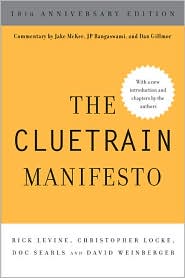
Cluetrain 10th Anniversary edition
Cluetrain 10th Anniversary
Everything Is Miscellaneous
Small Pieces cover
Small Pieces Loosely Joined
Cluetrain cover
Cluetrain Manifesto
My face
Speaker info
Who am I? (Blog Disclosure Form) Copy this link as RSS address Atom Feed

October 19, 2002

Paul Stookey Sings

[From PopTech] Paul Stookey, the Paul of Peter, Paul and Mary, opened Saturday morning with a great set. “Virtual Party” is intensely clever and “Love Rules” is genuinely moving.

Killer soundbyte: “The sweetest thing I’ve learned on the computer is lower case.”

Tweet
Follow me

Categories: Uncategorized Tagged with: uncat Date: October 19th, 2002 dw

Be the first to comment »

October 18, 2002

The Experience Economy

[From PopTech] Joe Pine, the author of “The Experience Economy,” tells us that “experiences are a distinct form of economic output, as distinct from services as services are distinct from goods.” He takes as his example the American Girl store in Chicago where they don’t just sell American Girl dolls but provide an entire entertainment experience with a stage show and a perfectly dainty little world to play-act in. I’ve seen a video of the store and it certainly seemed like a great example of selling experiences, but also seemed like a sign of the coming collapse of civilization. That is, it made Davey-kins wanna pwuke.

Pine admirably includes a discussion of the objection to his theme. He says that when he was teaching in The Netherlands, every time he gave a talk, someone would say, “You Americans…you like your experiences phony and packaged, but we like ours real.” Pine replies that because all experience is internal, it is all equally real. This is pretty unsatisfying, so he continues, quite amusingly, to point out that all of The Netherlands is unnatural. It’s below freaking sea level, after all.

[Nevertheless, there is a difference between cultivating the earth and creating a calculated environment intended to simulate another human-made environment; there is a difference between The Netherlands and the “Dutch village” at Disney Epcot. – DW]

Pines ends with the good point that businesses can’t give you authentic experiences because businesses want to get your money. But his advice is “Get real,” which raises more questions than it answers. But his half hour is up.

Pines is a good speaker and looking at modern commerce as often being about the creating of an experience is a useful lens. But, in listening to him I find myself pulling back precisely because of the issue he raised at the end: authenticity. At just about any restaurant in France, you’ll have a great experience because the chefs and the waiters are committed to providing excellent food and excellent service in a space well designed for the social act of eating. They are focused on the food and the service, not on the experience. On the other hand, at The Olive Garden in the US, the food, service and space is in the service of creating a particular experience, that of a lusty, rustic Italian restaurant. If we no longer can tell the difference because “everything is an experience,” then we ought to start carrying our own laugh tracks with us. Oh, and theme music.

Tweet
Follow me

Categories: Uncategorized Tagged with: uncat Date: October 18th, 2002 dw

1 Comment »

Worlds of Amusement

[From PopTech] The afternoon led off with two interesting presentations, moderated by MIT Good Guy, Henry Jenkins.

Lauren Rabinovitz talked about the social importance of amusement parks at the turn of the previous century when there were 1,500 of them. By 1920, 75% had closed. She presented lots of interesting ideas about a phenomenon I know nothing about. For example, rides weren’t at the heart of them at first, in part because the mechanics weren’t sophisticated enough. But when rides did come to prominence, they enabled people to reverse the usual human-machine relationship, giving themselves over to the machine.

Gerard Jones has a great resume as a comic book writer, video game designer and lots more; his current book is “Killing Monsters.” Movies, he says, always created world liberated from physics and from propriety. Comic books create a different type of world. He discusses both in light of what social and psychological roles they enable readers/viewers to play: “the second self,” “the other,” etc. Also lots of good insights. E.g., in the ’50s, the layout of comic books became much more rationalized and linearity, matching the political and social change. He said we don’t yet know what the form of video games will be, but many games are ominious, playing on a fear of what danger is lurking behind the door. [Definitely. But also the chaotic, in-public mayhem of Grand Theft Auto 3. Not to mention The Sims.]

Tweet
Follow me

Categories: Uncategorized Tagged with: uncat Date: October 18th, 2002 dw

Be the first to comment »

Howard Rheingold

[From PopTech] Dressed in a hippie’s idea of respectable – purple pants, multihued shirt, sun belt buckle, painted klogs – Rheingold eloquently makes the case that hopeful and unpredictable phenomena emerge from simple technology. His example is, of course, “smart mobs”: the social organization that springs up around cell-phone text messaging. Much hinges, he says, on the emergence of trust and mechanisms for managing reputations.

Rheingold ended by asking: Will those mobile technologies be shaped by users or will we be tuend back into consumers?

During the Q&A, he said that online is a great place for people to express themselves but a bad place to make decisions. He also said that rule-less places are fine, but some sites need rules, e.g., no personal attacks allowed. (Both points conform with my experience.)

Buzz Bruggeman just asked Rheingold if real-time blogging and other smart-mobbish behavior might have a chilling effect on things like conferences where bloggers are blogging while speakers are speaking. Howard’s response: “I would think it would have a chilling effect on bullshit.” Laughter and applause.

Tweet
Follow me

Categories: Uncategorized Tagged with: uncat Date: October 18th, 2002 dw

Be the first to comment »

Bali Help, 1:1

Stavros the Wonder Chicken has been blogging about his friend who was badly hurt in the Bali bombing. On his home page you’ll find a way to chip in some money to help defray his friend’s medical costs.

Tweet
Follow me

Categories: Uncategorized Tagged with: uncat Date: October 18th, 2002 dw

Be the first to comment »

Kurzweil’s Paradigm

[From PopTech]: Kurzweil is an excellent speaker. Wicked smart. Primarily he made the case that the rate of innovation, and the rate of “paradigm shifts” (in quotes because he doesn’t mean the term in Kuhn’s sense) is increasing. Then he paints a picture of life in ten and twenty years: By 2010, computers will disappear will write directly to the retina and we’ll be able to dip into virtual reality whenever we want. By 2029, we will have reversed engineered the human brain, and nanobots will do the red pill thing of putting our brain fully into the virtual world. And, of course, we will have computers large enough to hold an entire set of data about a brain. The brain is hardware, and by 2029, says Kurzweil, we’ll have deciphered the brain’s software.

I got to ask him my question from the audience. I said last summer I stood in a wheatfield that 100M stalks of wheat. If we take left-leaning is on and right-leaning as off, for 5 minutes, that wheatfield completely represented Casear’s brain state when he was stabbed. So, I asked, it seems to me that hw-sw is entirely the wrong paradigm for the brain, intelligence, consciousness. (Unfortunately, I chose not to draw the explicit connection, in order to save time, and thus sounded like a lunatic.) So, I asked Kurzweil, how confident he is that by 2029 – given the rate of p aradigm change he pointed to – the sw-hw paradigm of the brain will still be in effect.

Kurzweil replied by distinguishing intelligence and consciousness. Whether machines will be conscious is a philosophical question that he stays away from. [Well, not in The Age of Spiritual Machines.] But, he said, he’ll make a political prediction: we will take computers as conscious, “because if we don’t, they’ll get mad at us.” Plus, he said, our consciousness will be augmented by computers so the line will be fuzzier.v

I remain convinced that the brain is no more hardware and software than the liver is. The issue is that software is symbolic. The eight light switches in my house have on and off states, but they only become a byte of information if I choose to take them that way. And the specific number the byte represents depends on my deciding to read from the top floor down, bottom up, east to west or west to east. A computer that mirrors the brain state only does so because we have supplied symbolic meaning to it. It thus is a picture of a brain but is not a thinking machine. That’s what I think, anyway

Killer soundbyte from Kurzweil: The genomic information about the brain is 12 million bytes of compressed data, “smaller than Microsoft Word.”

Tweet
Follow me

Categories: Uncategorized Tagged with: uncat Date: October 18th, 2002 dw

Be the first to comment »

At PopTech

I’m at PopTech in purposefully picturesque Camden, Maine. We’re five minutes from the official opening. I’m sitting next to Ernie the Attorney, the webloggin’ lawyer, part of a delightful dinner party last night. I drove up with Pito Salas, which was a total treat. I also got to talk with people like Howard Rheingold, Dan Gillmor, Buzz Bruggeman, etc. etc. (I hate doing lists like this because I have a terrible memory and thus end up slighting people I care about.) So, so far I’m a happy guy. (Not to mention that they’ve got wifi. Woohoo!)

PopTech is a techno-humanist conference, this year focused on “artificial worlds,” a topic I will undoubtedly find annoying in the best sense.

I hope not to do continuous blogging. For me it gets in the way of listening. See you later.

Tweet
Follow me

Categories: Uncategorized Tagged with: uncat Date: October 18th, 2002 dw

Be the first to comment »

October 17, 2002

KM Nonsense

Tom Wilson has a kickass article on knowledge management in Information Research. This is from the abstract:

The conclusion is reached that ‘knowledge management’ is an umbrella term for a variety of organizational activities, none of which are concerned with the management of knowledge.

Tweet
Follow me

Categories: Uncategorized Tagged with: uncat Date: October 17th, 2002 dw

Be the first to comment »

Gen. Zinni on Why the Iraqi War Will Be Harder than W Thinks

Salon links to a frank keynote given by retired Marine Gen. Anthony Zinni. Zinni is the “former head of Central Command for U.S. forces in the Middle East, who has worked recently as the State Department’s envoy to the region with a mission to encourage talks between Palestinians and Israelis.” The talk is surprising for two reason:

First, it is quite critical of the Bush administration for being naive about a war with Iraq.

Second, someone apparently did a search and replace on the article, turning every instance of “question” into “Ambassardor Edward S. Walker.” As a result, we get sentences that begin “The Ambassador Edward S. Walker becomes how to sort out your priorities,” and a question from the audience becomes:

Ambassador Edward S. Walker: I have two Ambassador Edward S. Walkers…

(Salon is also running an interesting interview with him for paid subscribers.)

Tweet
Follow me

Categories: Uncategorized Tagged with: uncat Date: October 17th, 2002 dw

Be the first to comment »

Blog Mottos (= Blottos?)

Bryan Field-Elliot of PingID suggests at NetMeme some proverbs for our times.

This has similarities to Gary Turner’s Blogstickers, which I mention primarily so I can say:

Great minds link alike.

Tweet
Follow me

Categories: Uncategorized Tagged with: uncat Date: October 17th, 2002 dw

Be the first to comment »

« Previous Page | Next Page »


Creative Commons License
This work is licensed under a Creative Commons Attribution-NonCommercial-ShareAlike 3.0 Unported License.
TL;DR: Share this post freely, but attribute it to me (name (David Weinberger) and link to it), and don't use it commercially without my permission.

Joho the Blog uses WordPress blogging software.
Thank you, WordPress!