


logo
EverydayChaos
Everyday Chaos
Too Big to Know
Too Big to Know
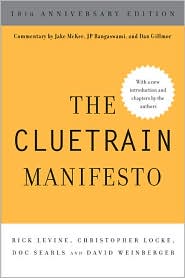
Cluetrain 10th Anniversary edition
Cluetrain 10th Anniversary
Everything Is Miscellaneous
Small Pieces cover
Small Pieces Loosely Joined
Cluetrain cover
Cluetrain Manifesto
My face
Speaker info
Who am I? (Blog Disclosure Form) Copy this link as RSS address Atom Feed

August 17, 2002

It’s so hot that…

I’m back in dial-up, low bandwidth doldrums. It is so hot here. I’m reminded of a joke from Prairie Home Companion that my children resolutely refuse to find funny:

“It was so hot that I saw a dog chasing a rabbit…and both were walking.”

Tweet
Follow me

Categories: Uncategorized Tagged with: uncat Date: August 17th, 2002 dw

Be the first to comment »

August 16, 2002

MegNut Rocks

MegNut’s new book is now available at Amazon. I haven’t gotten a copy yet, but given Meg’s experience and the fact that she is universally liked and respected (if you disagree, then shut up and go to hell), I’m looking forward to it.

She and her co-authors are releasing the book incrementally at their website. I just read the chapter on “Using Blogs in Business,” an excellent overview of the hows and the whys.

Tweet
Follow me

Categories: Uncategorized Tagged with: uncat Date: August 16th, 2002 dw

Be the first to comment »

Forrester on MP3s

Jonathan Peterson briefly summarizes a new Forrester report on MP3s and the recording industry:

Forrester has a new report stating the obvious: the music industry needs to let customers decide when, where and how they listen to music. Unsurprisingly, Big Content isn’t listening:

The music label executives we spoke with are so sure piracy is destroying their business, that they seemed strangely uninterested in the truth. After citing statistics about the sales of recordable blank CDs and threatening technical interdictions that would force pirates to reboot their PCs, one averred that “Research is useless at this stage.”

Interestingly Forrester forecasts a $2.1Billion business in downloadable music, led by a reinvigorated pop single marketplace and big fans who are willing to snap up productized digital “bootlegs”, singles, and live versions of major acts.

Peercasting is completely beneath the Forrester radar at this point. They are predicting that the egregious CARP fees can be made up by the revenues generated by selling singles while listening. Unfortunately, no internet radio station has the deep financial pockets needed to build the

Fear makes people stupid. Unfortunately, we are all likely to suffer from the recording industry’s fear.

Tweet
Follow me

Categories: Uncategorized Tagged with: uncat Date: August 16th, 2002 dw

Be the first to comment »

August 15, 2002

Michael Jackson and Me: Separated at Birth?

I’ve complemented the truly scary page that documents Michael Jackson’s facial transformations with a pictorial chronicle of my own facial shenanigans.


1972

Tweet
Follow me

Categories: Uncategorized Tagged with: uncat Date: August 15th, 2002 dw

Be the first to comment »

Lessig: America’s Most Important Pessimist

Darwin “Print Is for Losers” Magazine has a pithy interview with the most depressing man in America, Lawrence Lessig. Unfortunately, Lessig — a national treasure — has earned his pessimism. In short, he’s right. Imagine a prophet with a law degree.

The interview gives an excellent overview of Lessig’s thought. Every answer is quotable, so, almost at random, here’s Lessig on the threat to innovation:

The reality now is that every new innovation has got to not only fund a development cycle and fund a marketing cycle, it’s got to fund a legal cycle during which you go into court and demonstrate that your new technology should be allowed in the innovative system. In that context, there’s an extraordinarily high burden on innovation …

(There’s more on a related topic – Real World End User Licenses – right below…)


[I am very reluctant to mention myself in the same breath as Lessig who is, as I’ve said many times before, one of my heroes. But Darwin also today published a column of mine on the three precepts of digital rights management.]

Tweet
Follow me

Categories: Uncategorized Tagged with: uncat Date: August 15th, 2002 dw

Be the first to comment »

Real World End User Licenses: Defaulting to Stupidity

Doc points to a commentary in the same general area of Lessigness: Ed Foster writes in Infoworld on the spread of end user license agreements to printed material. His example is a book on “Geriatric Care Guidelines” from Omnicare, sent unsolicited to physicians. A label warns you not to open the shrink-wrapping unless you agree with the license which, basically, forbids you from telling anyone what’s in the book.

This is an egregious but not unique example. Lots of printed documents have conditions attached to them. Consulting companies routinely put a footer on every page of their reports that forbid photocopying. And non-disclosure statements routinely preface business documents. We usually don’t feel there’s anything wrong with that, perhaps because the inefficiency of the real world ensures a reasonable leeway: nobody’s going to know if you run off a copy of part of the report to distribute at an internal meeting or if you tell your spouse about the interesting proposal you heard today. In both cases, you’re violating the license, but far from doing any harm, you’re actually furthering the author’s interests — the consulting firm is further entrenched and you have a chance to think out loud about the proposal with someone outside your limited perspective.

The digital world affords the new possibility of zero leeway. The problem with digits is that they’re so simple. That is also their great strength, of course. They’re so simple that they can be tracked perfectly. They’re so simple that we can’t tell just by looking at them whether they are helping an author’s cause or subverting it. So, we are desperately trying to make the mistake of erring on the side of strictness.

Why is this a mistake? Because “Moving my ideas into a purchaser’s head” is only rarely the real intent of a creator. Far more often the intent is much richer than that: to have her ideas make a difference, to be appreciated and even loved for her ideas, to have her ideas start an open-ended process of development. Digits don’t know from that ambiguity. We — by which I mean the distribution industries, the government and even most of us “content creators” — are doggedly trying to reset the default to what is simple and unambiguous. But, defaulting to the simple and the unambiguous is nothing but a definition of stupidity.

What we thought was an undesirable weakness of the real world — its inevitable leeway — in fact is a strength because it accommodates the basic point of communication: to be ambiguous enough in meaning and scope to provoke results, growth and innovation in unpredictable ways.

Besides, didn’t James Bond defeat the evil forces of Omnicare in “You Only Play Once”?

Tweet
Follow me

Categories: Uncategorized Tagged with: uncat Date: August 15th, 2002 dw

Be the first to comment »

Cory on the FBI

Doc also notes Cory’s Argument by Analogy against the FBI advisory that warchalking may lead people to “steal” access via your wireless networks. Cory draws the analogy to windows (the glass things you put a blanket it over to eliminate the distracting glare of the real world). Well put.

Tweet
Follow me

Categories: Uncategorized Tagged with: uncat Date: August 15th, 2002 dw

Be the first to comment »

August 14, 2002

Practical AI

If you want to see some really useful AI, read the interview with the people designing the AI system for the new edition of No One Lives Forever over at PCGamer.com

Tweet
Follow me

Categories: Uncategorized Tagged with: uncat Date: August 14th, 2002 dw

Be the first to comment »

An Auto-Categorizing Search Engine

I spent some time on the telephone with the folks at Endymion who are excited about their ZNow search capabilities. And I have to admit, it’s pretty durn cool in the non-flashy-but-useful way. ZNow is a search engine that does the usual stuff (indexes HTML, Word, PDF) but also does quite a reasonable job of dynamically suggesting categories by which you can refine your search. (Note: My comments are based on a few minutes of kicking at a couple of demo sites.) For example, at a demo site that uses the content of the Open Directory project for its contents, if you search on “Jazz,” the right side lists the results but the left side lists about 20 categories by which you can further specify your search. The list is quite reasonable: arts, styles, dance, instruments, blues, band, performing args, classical, rock, guitar, etc.

Most interesting, the list is developed dynamically. Other engines suggest categories and folders but they require specifying the categories ahead of time. ZNow instead uses the word usage patterns of the pages in the results list to dynamically compute suggested categories.

It’s designed for intranets and extranets and is competitively priced against Verity, which means that you’re looking in the low hundreds of thousands for reasonable installations.

Tweet
Follow me

Categories: Uncategorized Tagged with: uncat Date: August 14th, 2002 dw

Be the first to comment »

August 13, 2002

Salon on Small Pieces and the Web

Scott Rosenberg at Salon uses Small Pieces Loosely Joined and Bamboozled at the Revolution (by John Motavalli) on which to hang a State of the Net address. Excellent essay, not that the nice things he says about my book influenced me at all.

(Scott, I’m ready to have your babies. Call me.)

Tweet
Follow me

Categories: Uncategorized Tagged with: uncat Date: August 13th, 2002 dw

Be the first to comment »

« Previous Page | Next Page »


Creative Commons License
This work is licensed under a Creative Commons Attribution-NonCommercial-ShareAlike 3.0 Unported License.
TL;DR: Share this post freely, but attribute it to me (name (David Weinberger) and link to it), and don't use it commercially without my permission.

Joho the Blog uses WordPress blogging software.
Thank you, WordPress!