



logo
EverydayChaos
Everyday Chaos
Too Big to Know
Too Big to Know
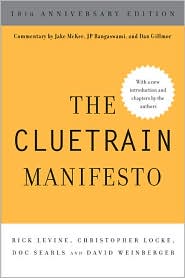
Cluetrain 10th Anniversary edition
Cluetrain 10th Anniversary
Everything Is Miscellaneous
Small Pieces cover
Small Pieces Loosely Joined
Cluetrain cover
Cluetrain Manifesto
My face
Speaker info
Who am I? (Blog Disclosure Form) Copy this link as RSS address Atom Feed

August 27, 2002

Hope for the despairing: Telcos vs. Hollywood.

Jonathan blogs about a Declan interview “with a lawyer from Verizon that has some very hopeful bits. … The short story is that The sleeping giant of the telcos, has political clout that puts Hollywood to shame, but let’s not forget that they may be out allies for now, but they ain’t us, and their agenda isn’t ours.”

Tweet
Follow me

Categories: Uncategorized Tagged with: uncat Date: August 27th, 2002 dw

Be the first to comment »

Lessig, Winer, Sifry, Lessig: The Quest for n

I wrote a brief reply to Dave’s “It’s simple” reply to the following blog entry…
Dave Sifry thinks carefully about the arguments being advanced by Dave Winer and Larry Lessig about software copyrights. As Doc says, Sifry is moving the discussion forward, a good thing.

In a nutshell (i.e., annoyingly inaccurately), Lessig proposes a 10-year copyright for software, after which the source code would be released into the public domain. Winer thinks this would unduly damage small software houses: “If we have to publish our source code the users won’t pay for it. Ten years isn’t enough time to create a new market.” And that would mean the end of the major incentive for innovation.

Sifry disagrees with Winer on this: “I can’t think of a single example of software that generated revenue 10 years after it was written, unless you’re talking about software for the Space Shuttle or some other old piece of hardware…”

That’s the swerving point in this debate, the point at which the conversation starts to head into the weeds. All contending parties agree, I believe, that (1) the goal is to build a marketplace that encourages innovation and (2) that the way to do that is to let the market reward innovation. Unfortunately, to spread the value of innovation, two things have to happen that are contradictory from the market point of view: First, someone has to have a great idea for which she is rewarded. Second, you want that idea to spread and be built upon as raidly as possible and requiring that the creator be rewarded slows down the spread. Much butting of heads ensues.

So, the reasonable compromise (as I think all the disputants agree) is to set some number of years during which a copyright holds. The question is: What’s the right number of years? More important, how do we decide the right number of years?

We can’t merely be guided by individual instances where a copyright of n years would have been clearly too long or too short, for the essence of the compromise is that we’ll tolerate some inequity in service of a larger growth in equitable innovation.

Further, n is going to be different for different industries, applications and hardware platforms: Some areas have the metabolism of hippopotami and others of hummingbirds. There is no n that is optimal for each body type.

So, how do we move forward? Some numbers would help:

What is the average/typical revenue curve (dollars vs. time) for software?

What’s the curve in various industries, hw platforms application areas?

Do we have reason to think that the curve is about to change its shape or that it could change its shape in desirable ways?

What is the curve for software that we (subjectively) consider to be innovative?

I’m a humanities major and thus won’t understand the numbers even if someone has them, but otherwise it’s hard to see how the discussion can go much further.


Lessig’s reply to Charles Cooper is a superb piece of rhetoric in the best sense: clear, persuasive, entertaining. He even uses one of Winer’s proudest software creations as his example of why we want to limit the term of software’s indentured servitude.

Tweet
Follow me

Categories: Uncategorized Tagged with: uncat Date: August 27th, 2002 dw

Be the first to comment »

August 26, 2002

Ernie D’Attorney’s Sensible Suggestions

Ernie the Attorney has some nonsensible suggestions for Congress. Hell, they’re no more absurd than the actual proposed legislation…

Tweet
Follow me

Categories: Uncategorized Tagged with: uncat Date: August 26th, 2002 dw

Be the first to comment »

Signs of life

Distributed expertise

The current issue of Vanity Fair has an article (by David Rose) on the crash of AA Flight 587 a few months after 9/11. The point of the article is that the FAA’s explanation (pilot error in reaction to turbulence from the aircraft in fron of it) is very likely wrong. And the FAA is being suspiciously protective of the data it holds. In fact, suggests the article, there are structural problems with the aircraft. (I could swear I read this same article a year ago, maybe in the NYer.)

Anyway, the article supplements the data the FAA has released with information from a site where “a network of aviation experts, former crash investigators, pilots and engineers” analyze information from multiple sources, trying to piece together what actually happened.

Networked markets are smarter than the companies they’re talking about and networked experts know more than the government wants them to know.

Conversation is In

Because I am a Cluetrain guy, I am unnaturally alert to the discovery of convesation, for the central idea of that decentralized book builds on Doc‘s insight that “markets are conversations.” So are businesses (as Fernando Flores said, although in a different way) and so is the Internet itself. This idea struck us four authors as especially worthwhile given business’ insistence on understanding the Net as a type of ultra-cheap broadcast medium.

So, it is almost certainly only a coincdence that in the current issue of The New Yorker (a double issue for Aug. 19 and 26), Adam Gopnick’s excellent-as-usual article on cooking ends with this insight:

Searching for an occult connection between cooking and writing, I had missed the most obvious one. They are both dependencies of conversation. What unites cooks and writers is that their work flows from the river of human talk around a table…I enjoy the company of cooks, I realized, because I love the occasions they create for conversation.

Not all that sensible, perhaps, because Gopnick should then equally enjoy the company of furniture makers and farmers. But, I like the reveling in conversation.

Then, putting that magazine down, I picked up the NY Times Week in Review and read an article called “The Selling of America, Bush Style” by Victoria de Grazia about the Bush administration’s attempt to “rebrand” the US. She points to two obstacles. First, “there are now so many competing mesages…” Second,

…advertising messages in themselves have so little bite. They are like one-way streets. Effective cultural exchange, by contrast, depends on engaging others in dialogue.

Jeez, maybe Cluetrain was right! Is the Internet spreading the cult of conversation, which is, after all the second most basic form of human sociality.

Tweet
Follow me

Categories: Uncategorized Tagged with: uncat Date: August 26th, 2002 dw

3 Comments »

Google Logos

There are some amusing plays on the Google logo at SomethingAwful.

Tweet
Follow me

Categories: Uncategorized Tagged with: uncat Date: August 26th, 2002 dw

Be the first to comment »

August 24, 2002

Spamming Dead Meat

According to a study by Address Guardian (and reported in MediaPost), 17 million US households receive direct mail and telemarketing addressed to a dead person. Four million get “a lot” and 53% of the mail is going to people who have been dead for a year or more. 6% goes to people who have been dead for 10 or more years.

In my will, I’ve specified that my heirs should keep my email address active and that all incoming mail should be automatically answered with a personalized response expressing my great interest in their products, services, offers of stolen government funds, webcam views of their hot coed selves and, of course, penis extenders.

Count it as my own web-based perpetual flame.

Tweet
Follow me

Categories: Uncategorized Tagged with: uncat Date: August 24th, 2002 dw

Be the first to comment »

August 23, 2002

NPR Commentary

Note: I screwed up. Someone told me that NPR’s “All Things Considered” ran a commentary of mine last night and I assumed it was on copyright. But I just found out that it was in fact one on the sociality of the Web. But, enough people have linked to the NPR commentary that didn’t run yet that I’m posting it here as an unofficial draft. The transcript below is of the one that did run last night. You can listen to it here.

I’m not a tremendously sociable fellow. Like a surprising number of people in my age and socioeconomic group, I don’t have a lot of friends I hang out with. I think — I hope — it’s just the nature of modern life.

But then I think about my email life. I spend a whole lot of time engaged in really stimulating conversations with strangers. There’s not a day that goes by that I don’t get at least one email from someone I’ve never met — messages on interesting topics from people who, through the constant hand-off networking of the web, think I might be interested in what they’re interested in. I write back, the stranger responds, and this goes on for a couple of days. Then, typically, it peters out … and sometimes we bump into one another again on the Web..

The exchanges always have their own character. Some are sober and direct. Some are wordy and formal. Most are jokey, sarcastic, outright funny. In short, the messages sound like their authors, but use the near-universal web attitude of irreverence and humor to cushion the stating of beliefs that may be directly at odds with your reader. “Hey, man, it’s just a joke, it’s got a smiley face next to it.” Humor is becoming the format for intellectual content just as dry sobriety and rigor used to be.

The great thing is that this email arrives unasked for. Someone in the Netherlands, or Australia, or South Africa read some message I posted to a discussion board on the Web, the Web, or stumbled across my home page, or were referred by a friend or previous a correspondent.That’s the nature of the Web, a network that gets its value from people stumbling around.

And I start conversations all the time. I read about an interesting a couple of days ago, so I found out a little more about it on the Web, got the author’s email address, which she publishes, and I wrote to her to talk about an interset I think we share. An hour later, her reply was in my mailbox. A couple of exchanges and we’re allies whose paths may well cross again.

Today I heard from a stranger who thought I’d be interested in something called “pattern language.” He obviously cares about it a lot. So, he educated me briefly and gave me a perspective I might never have stumbled on. Two messages and it’s over. Maybe.

This morning, a guy came across my site and asked me to comment on his. I sent him a message critiquing but now I think he probably just wanted me to say “Cool site!” and share his enthusiasm. So, I think I made a mistake. I haven’t heard back from him. I have no idea whether he’s sulking, found my comments helpful, or now thinks I’m a moron. Maybe all three. That’s part of the conversation too.

What do I get out of this Clearly, stimulation. But it feels deeper than that. The world is coming unstuck in the very best of ways. We’ve lived under a rigid system for managing social contacts. The people you don’t know are strangers. You don’t speak unless spoken to. You stay formal until you get to know one another. Not any more. I sense a spiritual mandate to connect, a mandate so deep that it feels biological. We must find one another, now. We have to grip every hand that we see. This is the new evolution. We are building a world, we’re building the real web, the one that uses technology for connection the way our souls use our bodies for awareness. It’s just email. But it’s joyous.

Tweet
Follow me

Categories: Uncategorized Tagged with: uncat Date: August 23rd, 2002 dw

Be the first to comment »

Bushanalysis…

Joe Mahoney — whose weblog I’d missed despite the fact that Joe is an old friend, the most literate amateur I’ve ever met (as opposed to professional professors), an astounding musician, and a role model — and I ended up arguing in email about W’s twisted psychology. Joe has run the correspondence. Although he says I trumped him, his last paragraph, with its Frenchification and Lacan reference, is a thoroughly enjoyable classic of intellectual rug-pulling.

Here’s my “analysis.” It is, as always, highly scientifical.

The family is dominated by Babs. She is a classic bitch-tyrant, passive-aggressive mother. Jeb was the favorite. W was the drunk ne’er-do-well who had to be propped up by his father’s cronies; his only validation, as a “successful businessman” he knows came through his father’s largesse, which he hates because he hates his dependence on it.

Once in office, he has surrounded himself with Dad’s pals because that’s the only way he knows how to succeed, but he resents it and can’t feel like a success (or a man) so long as he does what they say. (But he is afraid not to do what they say). He has to do Poppy’s job better than Poppy did. Why? So he can beat his two rivals – Dad and Jeb – for the approval (= fucking) of his mother. So, it won’t be enough for him to beat Dad at the presidency game. He’s also going to have to do it in the face of the advice of Dad’s Greek chorus that’s been guiding him so far. The defection of elder Republicans from the Bomb Iraq cause only gives W a bigger hard on for it.

He has had two opportunities to beat Poppy. Only two people have ever caused Poppy to fail: Clinton and Saddam. Having beaten Clinton, it’s on to Saddam. W has a love/hate deal going with Saddam because although Saddam humiliated the father who never loved him (and who still has the good graces to appear embarrassed with him), Saddam has also given W the opening he needs to win Mommy. He’s not after revenge. It’s approval he’s after. In support: his overwhelming need to be liked is all too obvious, right down to the juvenile nicknames he gives people. His infantilizing of global politics (Putin is “Pooty-poot,” the comic book rhetoric of “evil doers”) undoubtedly (hah!) goes back to his failure to win approval as an infant. He is stuck there.

The Oedipal nature of the Iraqi threat (or opportunity, as it appears to W) implies that he will penetrate Iraq violently, preferably by inseminating it with sperm sprayed from above . His operative metaphor is probably (i.e., I’m making this up) “shoving a smart bomb up Saddam’s ass” to degrade him (= Poppy) sexually so that the Mama Bush will prefer him. W’s no bush! He’s a bomber!

Your comments on his oral fixation ring true to me (which unfortunately does not mean they’re any more likely to be true) and I assume that the oral sex with Laura – and whatever other Dallas Debbies he did during the Drunk Years – was one-way, brutish and unreciprocated.

So, if we could just persuade Babs to blow him, preferably after Dad’s gone limp while trying to perform his husbandly duties, the world might yet be saved. Why don’t you write to her and suggest that?

Go to Joe’s site to read his concluding comment. Stay for the poetry and the voice and the ideas.


Based on nothing but what I saw this morning on the talk shows (when my family’s away I snap on the TV first thing so I can hear voices I can ignore) the public discussion of Sami Al-Arian isn’t asking the basic question: Is he a good teacher and scholar? If he’s doing illegal things outside of the classroom — and according to Al-Arian, a judge last year declared that the groups for which he participated in fund raising were not supporting terrorism — then the legal system should deal with it and, if convicted, he should be bounced from the university. Otherwise, he should be free to say and do what he wants outside of the classroom.

Now, the nit in the ointment is that the University of South Florida claims he’s in violation of his employment agreement and I don’t know what that agreement says. Oh wait, I just found a copy. Sure enough, right there in Paragraph 32c it says: “Tenured professors can be fired if doing so enables Jeb Bush to look tough.” Too bad, Sami. You shoulda read the fine print.

Tweet
Follow me

Categories: Uncategorized Tagged with: uncat Date: August 23rd, 2002 dw

Be the first to comment »

August 22, 2002

Net at Work

According to the results of a new study, as reported by Jim Meskauskas at MediaPost:

…the at-work Internet user spends more time with the Internet than he does with any other media. According to the study, the share of total minutes of media consumed using the Internet is 34% among the at-work audience. That means that 34 of every 100 minutes of media consumed belong to the Internet. That is more than any other medium (television accounts for 30%).

That’s good but not unexpected news for us Net boosters. But could you please tell me at what job you get to spend 30% of your “media time” watching TV?

Tweet
Follow me

Categories: Uncategorized Tagged with: uncat Date: August 22nd, 2002 dw

Be the first to comment »

The Two Reasons Marketers Can’t Understand the Web

1. They can’t tell the difference between a party and a market.

2. They think it’s their party.

About #1. Marketers think that we on the Web are markets. They define a market as a group of people who will respond favorably (i.e., 2% will twitch their eyebrows in reaction) to a message. For example, “urban males 18-24” is a market if they will respond favorably to an ad with a babe touching a pen to her lips, and “people who read Parade and own a weimeraner” is a market if they respond favorably to a jingle that rhymes “wet good” with “pet food.” These markets have no existence as a group except as a statistical abstraction. They are not real groups, much less communities on conversations. The Web, on the other hand, is a set of global parties where people are talking with others only insofar as we find one another interesting on some topic. Marketers look at these parties, these real groups of real people, and see only opportunities to deliver messages.

About #2. The fundamental mistake business insists on making over and over on the Internet is to think that their Web site is theirs. Even if they have learned that the Internet is not driven primarily by business, just about every business thinks about its site as a piece of property they own. When we enter it, we are now subject to their rules and their messages. While this is legally indisputable, it’s also what makes business sites feel so alien on the Web.

[For further reading: Cluetrain, Gonzo, Doc.]


Scott Knowles, a marketer whose head is not up his ass when it comes to the Web, responds: “I think putting a “traditional” in front of “marketing” when your slamming it would make things more accurate. There really is a difference.” Yes, there is. I assume a “traditional” in front of “marketers” in the screed above, but I shouldn’t assume that all me readers assume the same assumption. (You know what they say about “Assumptions”: they make an “ass” of “u” and “mptions.”

Tweet
Follow me

Categories: Uncategorized Tagged with: uncat Date: August 22nd, 2002 dw

Be the first to comment »

« Previous Page | Next Page »


Creative Commons License
This work is licensed under a Creative Commons Attribution-NonCommercial-ShareAlike 3.0 Unported License.
TL;DR: Share this post freely, but attribute it to me (name (David Weinberger) and link to it), and don't use it commercially without my permission.

Joho the Blog uses WordPress blogging software.
Thank you, WordPress!