


logo
EverydayChaos
Everyday Chaos
Too Big to Know
Too Big to Know
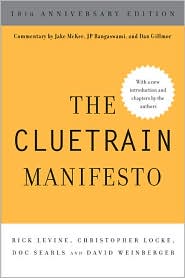
Cluetrain 10th Anniversary edition
Cluetrain 10th Anniversary
Everything Is Miscellaneous
Small Pieces cover
Small Pieces Loosely Joined
Cluetrain cover
Cluetrain Manifesto
My face
Speaker info
Who am I? (Blog Disclosure Form) Copy this link as RSS address Atom Feed

May 11, 2002

Bad Milk: The Game Bad

Bad Milk: The Game

Bad Milk is a very odd game. It uses video snips in a Flash-like fashion to pull you through an hallucinogenic story line that begins when you drink some milk past its expiration date. I only have the demo but it’s pretty durn compelling so far.

Tweet
Follow me

Categories: Uncategorized Tagged with: uncat Date: May 11th, 2002 dw

Be the first to comment »

threadsML The discussion about a

threadsML

The discussion about a standard to enable the sharing of message threads is picking up steam over at QuickTopic. The standard, tentatively named “threadsML” may be broad enough to cover blogthreads although blogthreads are hyperlinked, not threaded; that is, a blog entry in a blogthread may have more than one parent.

If you’re of a mind, feel free to jump into the discussion.

Tweet
Follow me

Categories: Uncategorized Tagged with: uncat Date: May 11th, 2002 dw

Be the first to comment »

Turing Support Machines Kevin Marks

Turing Support Machines

Kevin Marks responds to the transcript of a “conversation” with a Microsoft support bot:

Customer service people routinely fail Turing tests because they are told to follow a script. They are part of a programmed machine. My friend Stuart is comfortable with this, as if they are programmed, he can find the bugs and exploit them to get what he wants anyway.

see my Edemame piece.

In this piece Kevin manages to compare authentic voices with boiled soy beans. And he succeeds.

Tweet
Follow me

Categories: Uncategorized Tagged with: uncat Date: May 11th, 2002 dw

Be the first to comment »

May 10, 2002

Viva el Lessig! Larry Lessig,

Viva el Lessig!

Larry Lessig, everyone’s favorite freedom fighter, gives a terrific interview to BusinessWeek (but you already know that because you saw it at Doc’s blog on Wednesday). Lessig says:

We don’t need a new vision. We just need to recognize what the traditional vision has been. The traditional vision protects copyright owners from unfair competition. It has never been a way to give copyright holders perfect control over how consumers use content. We need to make sure that pirates don’t set up CD pressing plants or competing entities that sell identical products. We need to stop worrying about whether you or I use a song on your PC and then transfer it your MP3 player.

Lessig is crucial to the movement that’s waiting to happen. He’s got the right combination of expertise, clear-headedness, articulatenessosity, integrity and passion. I’ve had the opportunity to meet him a few times and can attest that, as an added bonus, he’s a really good guy.

And you know what? Even with people like Lessig at the forefront, we’re still probably going to lose. In fact, we lost as soon as the greedy bastards got us to accept the idea that the songs and essays and poems we write are a type of property.


Speaking of freedom struggles, Mary Lu has blogged links to a webcast of the International Webcasting Association’s three-hour town meeting on CARP and the attempt to shut down Internet Radio.

Tweet
Follow me

Categories: Uncategorized Tagged with: uncat Date: May 10th, 2002 dw

Be the first to comment »

Friday Funnies From Ian Poynter

Friday Funnies

From Ian Poynter comes a link to the Action Man comic book for all of us who have sat through a meeting before. Very funny.


Matthew Flemming recently had a chat-based run-in with Microsoft support. He’s allowed me to post the transcript. Is it an encounter with an inept support person or a frustrating talk with poorly designed software? And if we can’t tell, has it therefore passed the Turing test?

Tweet
Follow me

Categories: Uncategorized Tagged with: uncat Date: May 10th, 2002 dw

Be the first to comment »

May 9, 2002

MiscLinks Eric Norlin is convinced

MiscLinks

Eric Norlin is convinced that now’s the time — at last — to resolve the knotty problem of digital IDs, and he’s preparing to dig into it. His interview with Microsoft at DigitalIDWorld topic gets them on the record on the important aspects of this question.


Dan Bricklin has written an excellent report on the Nantucket Conference. This type of coverage — personal, reflected through someone as knowledgeable and thoughtful as Dan — is invaluable. Of course this was done before there were weblogs, but weblogs are making the sharing of post-conference reflections an important part of the conference itself.

BTW, Dan says nice things about my presentation at the conference and presents a summary that’s more coherent than my ramblings. I have already received an email from someone totally pissed that they wasted a click going from Dan’s site to mine. I understand someone not liking what I’ve written, but I can’t figure out the pathology of someone who writes to me just to tell me that I suck. What’s he get out of it? Ah humans. Can’t live with ’em, can’t drink yourself into oblivion long enough.


Required reading from Clay Shirky on the DNS mess. You’ll also want to read Bob Frankston for an opposing view.


Jadine Ying has an article on blogs and the J word at Spike, the magazine of the Dept. of Journalism at the University of Illinois. It focuses on the High End of bloggery, citing the Glenn Fleishman, Paul Boutin and Doc Searls cut of the jib, but that makes sense given that the article is about where the Big J meets the swarm of B’s.


Peterme recommends an article called “Blogging Thoughts: Personal Publication as an Online Research Tool” by Torill Mortensen and Jill Walker. They write:

Bloggers have been likened to journalists, or perhaps better, editors; they might as well be compared to researchers. To blog is an activity similar in many ways to the work of the researcher. A weblogger filters a mass of information, choosing the items that interest her or that are relevant to her chosen topic, commenting upon them, demonstrating connections between them and analysing them.

Refreshingly, each of the authors actually has experience blogging:

[O]ur weblogs became tools with which to think about our research, its values, connections and links to other aspects of the world. They altered the way in we approached online communication, and have influenced the writing of both dissertations. This is the motivation for this article: a need to look at what weblogs do to our academic thinking.

They state outright that they are not objective or detached. Woohoo! As they say: “Blogs exist right on this border between what’s private and what’s public…When a blog is good, it contains a tension between the two spheres…” They then explore the changing nature of the public sphere, with Habermas as their starting point. Excellent, thought-provoking article.

Tweet
Follow me

Categories: Uncategorized Tagged with: uncat Date: May 9th, 2002 dw

Be the first to comment »

Kids Slam Philosophy The winner

Kids Slam Philosophy

The winner of the Kids’ Philosophy Slam has been announced, an essay contest in which students all write about the same topic. This year it was “Is Human Nature Good or Evil?” Congratulations to Vineetha Joseph who beat out 4,000 students from first grade to high school senior.

I was one of the judges and have some advice for next year’s entrants. It’s really very simple and it’s guaranteed to boost the grades on your term papers by at least 1.5 grades: Don’t ever answer the question directly. Always answer a meta-question. “The question isn’t whether human nature is good or bad. The real question is: What is human nature?” “The question isn’t whether the Civil War was caused by economic or social forces. The question is what it means for a large-scale human event such as a war to be ’caused’.” “The question isn’t what Jay Gatsby’s fatal flaw was. The question is what sorts of creatures we human beings are if we can be flawed or not.” Note: For philosophy courses, go up two levels of meta-question. It’s just that simple.

Tweet
Follow me

Categories: Uncategorized Tagged with: uncat Date: May 9th, 2002 dw

Be the first to comment »

RageBoy Testimonial Hour I was

RageBoy Testimonial Hour

I was going to point to an appreciation of Chris Locke by Jack Schofield in The Guardian anyway, but Tom beat me to it with a heartfelt personal testimonial that’s well worth reading.

Tweet
Follow me

Categories: Uncategorized Tagged with: uncat Date: May 9th, 2002 dw

2 Comments »

May 8, 2002

Boston, California According to our

Boston, California

According to our local rag (and it is a rag), one of our residents is suing to prevent his neighbor from adding a wing to his house. It seems that having a new door facing the plaintiff’s house will interfere with his house’s feng shui.

Tweet
Follow me

Categories: Uncategorized Tagged with: uncat Date: May 8th, 2002 dw

Be the first to comment »

Dreyfus on the Outside Julianne

Dreyfus on the Outside

Julianne Chatelain recommends a fascinating review by Geert Lovink of Hubert Dreyfus’ brief (136pp) book “On the Internet.”

Dreyfus is best known in the computing community for his classic “What Computers Cannot Do,” a book that applied the insights of Heidegger to the question of AI. I’ve always loved that book because it critiques AI from the right standpoint (IMO) – its implicit assumptions about consciousness – much as Andy Clark’s much more recent “Being There” does. I know Dreyfus, however, primarily for his Heideggerian scholarship and even once brought him in as a guest lecturer at a college at which I taught.

I haven’t read his new book. I only heard about it through Lovink through Chatelain. But the review is hefty and substantial. Based on it, it sounds like Dreyfus has chosen a dyspeptic stance towards the Net that in some ways mirrors my own mindlessly optimistic view. Says Lovink:

Dreyfus develops his version of ‘net criticism’ in four different fields:

the limitations of hyperlinks and the loss of the ability of to recognize relevance;
the dream of distance learning (no skills without presence);
the absence of telepresence
and a chapter on ‘anonymity and nihilism,’ leading to a life without meaning.

Lovink quotes the following:

“Thanks to hyperlinks, meaningful differences have been leveled. Relevance and significance have disappeared. And this is an important part of the attraction to the web. Nothing is too trivial to be included. Nothing is so important that it demands a special place.” (p.79)

and replies “There is no mention here of users and groups creating their own meaning and context on the Net. Dreyfus apparently never heard of mail and web filters.” Lovink astutely connects this fear of the rabble to its roots in the authoritarian impulse.

All I’d add, not having read the book, is that Dreyfus’ rant is the complaint of the outsider, the one who is refusing to enter the fray because he might get grass stains on his new pants. Merely browsing from site to site, chat to chat, the participants look like gibbering baboons. Enter into the discussion and you now find the conversations that matter to you, that expand your thought. In short, Dreyfus is making the dry fuss of a crotchety old man, yelling at the kids to turn down that racket, stop gabbing, and go to bed.

Jump in, Hubert. We need you. And, although you don’t know it, you need us.

Tweet
Follow me

Categories: Uncategorized Tagged with: uncat Date: May 8th, 2002 dw

4 Comments »

« Previous Page | Next Page »


Creative Commons License
This work is licensed under a Creative Commons Attribution-NonCommercial-ShareAlike 3.0 Unported License.
TL;DR: Share this post freely, but attribute it to me (name (David Weinberger) and link to it), and don't use it commercially without my permission.

Joho the Blog uses WordPress blogging software.
Thank you, WordPress!