



logo
EverydayChaos
Everyday Chaos
Too Big to Know
Too Big to Know
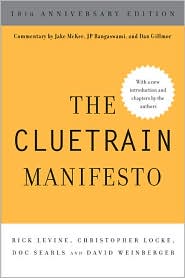
Cluetrain 10th Anniversary edition
Cluetrain 10th Anniversary
Everything Is Miscellaneous
Small Pieces cover
Small Pieces Loosely Joined
Cluetrain cover
Cluetrain Manifesto
My face
Speaker info
Who am I? (Blog Disclosure Form) Copy this link as RSS address Atom Feed

March 12, 2002

DayPop Titles I’m happy to

DayPop Titles

I’m happy to say that my blog entry on Web as Utopia made it into
the DayPop
Top 40
and then the follow-up on it made it in.
But I couldn’t understand why DayPop lists the
follow-up with the title “acknowledged and refined.”
Those words don’t appear on the page. DayPop’s title
for the first entry was just as odd.

Answer: “Acknowledge and refined” are the words
AKMA chooses to link to my blog entry. Aha! Or, possibly: D’oh!

Tweet
Follow me

Categories: Uncategorized Tagged with: uncat Date: March 12th, 2002 dw

Be the first to comment »

March 11, 2002

Here are some musicians Both

Here are some musicians

Both AKMA and Steve Himmer emailed me immediately in response to my blog about the music biz to say that They Might Be Giants have been doing the web-economics thing. Steve also points to Jane Siberry. Thanks.

Michael Fraase, of Arts and Farces, weighs in with www.etree.org, gdlive.com and StringCheeseIncident.com.

Tweet
Follow me

Categories: Uncategorized Tagged with: uncat Date: March 11th, 2002 dw

Be the first to comment »

Web Space, Web Place AMKA

Web Space, Web Place

AMKA responds to my meanderings about Web as utopia by wondering whether the Web is spatial at all. And well might he wonder since if the Web is spatial, it is definitely a weird type of space. Indeed, as AKMA says, “…space has dimensions of height, breadth, depth, all of which are absent (or extremely different) with relation to the Web.”

There was a really interesting discussion of the spatial nature of the Web over at Peterme‘s site that something I’d written spurred Peter to surface again. The point I was making (and make in my upcoming book) seems weaker than the rest of the discussion, but, fwiw, I argue that the Web is “place-ial,” not spatial for it has no dimensions. Rather, it consists of places, each of which has its own character and meaning.

But the main point of difference between me and AKMA on the spatiality of the Web seems to be that I’m trying to be a dutiful phenomenologist, pointing out that a weird spatiality deeply informs our Web experience, while AKMA seems in this instance to believe that we can change metaphors if the current ones are so based in real-world habits of thought that they “constrain our behavior.” AKMA writes:

How might we imagine the Web if we tried to conceive it nonspatially?

I am totally down with this project so long as we agree that what AKMA’s asking for isn’t a more accurate description of the Web because the current one isn’t effective. Instead, he’s asking for new poetry. And that’s much harder to do.

Tweet
Follow me

Categories: Uncategorized Tagged with: uncat Date: March 11th, 2002 dw

Be the first to comment »

Where Are the Musicians? From

Where Are the Musicians?

From a private discussion list comes a link to Ani DiFranco ‘s letter to Ms. magazine explaining the art-above-bucks ethos that enables her to escape the recording industry’s death clench.

Not caring about money is one way out. But why have there been no — NO — established bands that have been willing to try an alternative revenue model? Why has not a single band that we’ve already heard of released an album over the Internet either for free or for a third the cost of a CD (= 4x what they make from the recording industry)? Why not any experiments in giving away MP3s while selling a year’s subscription to the work of the band over the next year? Is it as simple as the fact that all established bands are locked into contracts that forbid them from innovating? Or have I simply missed the music sites that are economically innovative?

Hell, where are the book writers, too? (Oh, shut up!)

For those looking for the gumption to actually care about little things like profits and revenues, Eric Norlin’s latest econowarrior newsletter is highly recommended.

Tweet
Follow me

Categories: Uncategorized Tagged with: uncat Date: March 11th, 2002 dw

Be the first to comment »

March 10, 2002

Web as Utopia [This is

Web as Utopia

[This is what I remember saying to a session yesterday
at the Eastern Sociological Society meeting.]

I was an academic philosophy professor up until
about 17 years ago and I’ve spent the intervening
time doing my best to learn how to think sloppily.
What I’m about to say is an example. And, by the
way, I conflate the “Web” and the “Internet” because
that’s what the vast majority of users do.


I’m not defining a utopia as a perfect place.
Rather, it is a place with a particular nature.
Humans also have a nature. That’s probably a
terrible thing to say at a sociology meeting, but I
mean simply that — whether it’s socially
conditioned or not — there are characteristics
that make us humans. So, just go along with me for
now. A utopia is a place whose properties enable us
to perfect our human nature.

Now, I don’t mean that we become perfect in a
utopia. That’s not possible. We’re humans. We’re
imperfect. That’s why we’re not gods. Besides,
imperfection is the only thing that makes life
interesting. Perfection is homogenizing, at least
according to the tradition. Imperfection is where
all the fun and interest is. It’s a bit like the
fact that the price of free will is the existence of
evil in the world: the price of the world being
interesting is that we are imperfect creatures.

So, what I want to argue is that the
characteristics of a utopia that enable us to
imperfectly perfect our imperfect human nature are
properties the Web has.

First, utopias are always new starts, a fresh
page. The Web is definitely new and a fresh page.

Second, a utopia is a place and so is the Web. In fact it’s a world.
It is not a medium. A medium is something we send
messages through, and while we can do that with the
Web, I believe — and the fact that I believe
it should definitely be enough to establish it as a
fact ;) — that the excitement about the Web
hasn’t happened because it’s a messaging medium.
Rather, our language says that we move through the
Web. We, not our messages. This is very weird. While
the Web consists of pages, we go to them, enter them
and leave them. We don’t do that with real world
pages or documents. We experience the Web as a
navigable space.

This Web place has certain characteristics.

1. It’s persistent.That’s one reason we
experience it as a place. Sure, sites go up and
down, but there is a basic persistence to it, unlike other instantaneous media such as telephones and ham radio.

2. It’s conversational. It’s not really primarily
about companies marketing crap to us. The excitement of
the Web has something to do with the fact that we’re
connecting with one another by the most basic social
act: talking.

3. It’s hyperlinked. The Web wouldn’t be a web if
the pages weren’t linked. But every hyperlink is an
expression of interest. I link to your page because
I think my visitors might find your page
enlightening or amusingly wrong. The real world is
shaped by a geography of rocks and water. The Web
geography is shaped by links of human interest and
conversation.

Compare this to the real world. We’re born into
the real world. None of us asked to be born. Even if
God gave us the world as a gift, it’s still the
given, the datum. And fundamentally this world is
indifferent to us. We get buried in it, our atoms
dissolve, and the worms are happy and the atoms
don’t care. We make of this world what we will, but
it’s damn hard. You can’t move the mountains and it
takes a lot to make the desert bloom. It
fundamentally isn’t our world.

But the Web is a world that we’re making for
ourselves. And we’re doing so by connecting to one
another in conversation and by linking to one
another out of human passion and caring.

I can’t defend the following so I’ll just state
it: we humans are at our best when we are involved
with others. We are at our best when we are social
and connected. The Web is a world that is profoundly
social. Its geography itself is social, a map of
connections and passions. It is thus a world that
we’ve made for ourselves that is a reflection of our
best nature and a place where can imperfectly
perfect our imperfect natures.

Tweet
Follow me

Categories: Uncategorized Tagged with: uncat Date: March 10th, 2002 dw

Be the first to comment »

March 9, 2002

MiscLinks Why didn’t anyone tell

MiscLinks

Why didn’t anyone tell me that I Love Me Vol. I is Michael O’Connor Clarke’s blog! I really have to do a better job of keeping up. I’ve been urging Michael to publish his stuff for years because he’s sharp, funny and wickedly arch. It looks like with weblogging he’s found his form. I’m so excited!


Kevin Marks sends us to a site that scans your brain for memes and diagnoses which areas are most deeply infected.


Glenn Fleischman has a site that lists comparative prices for any book you care to mention. (Cluetrain for $2.99!)


Jonathan Peterson is recommending “bombstickers” as a way of playing with Google’s linked-based relevancy rankings. (Call me a stick in the mud, but I sort of don’t want to mess with Google’s rankings. Yes, I love Google that much.) (Jonathan counterblogs, capturing and better expressing the ambiguity I feel about googlebombing.)

John Hiler at MicroContent News has an article explaining the theory and practice of GoogleBombing.


Halley blogs in response to my proposed comments to the Instant Messaging conference. Insightful as always.

Tweet
Follow me

Categories: Uncategorized Tagged with: uncat Date: March 9th, 2002 dw

Be the first to comment »

A Joke I Didn’t Make

A Joke I Didn’t Make

Right before I was due to speak at the IM conference, I went to the men’s room. On the urinal was written “1.0 GPF” (gallons per flush), but the font for the F was odd so it looked like “1.0 GPL.” I decided not to begin my presentation by saying that for a moment I found myself thinking: Cool! An open source toilet!

It’s bold decisions such as that that makes me such a sought-after speaker and genial host. That and the fact that I look particularly good in a smoking jacket.

Tweet
Follow me

Categories: Uncategorized Tagged with: uncat Date: March 9th, 2002 dw

Be the first to comment »

March 8, 2002

Instant Messaging Conference Report The

Instant Messaging Conference Report

The Instant Messaging Planet Conference and Expo (“The Enterprise IM Strategies & Solutions Event”) going on in Boston yesterday and today attracted about 150 people for a lively set of discussions about moving IM into the corporate world. It presented a picture of an industry attempting to struggle out of the swamp of commoditization…with the lead commoditizer, AOL, not in attendance.

[Note: My view is doubly skewed. I am basically a populist when it comes to IM, and I only heard the morning panels, although I hung around after my keynote to talk with folks. So, this is hardly full and unbiased coverage. As if you needed to be reminded.]

The problem the attendees face is simple: Why should anyone pay for what they can get for free? Answer: Businesses should pay for it because of the features the vendors provide: security, integration with other apps, security, archiving, security, configuration for a particular set of business problems, security, the filtering of irrelevant messages, security, and security.

It’s no coincidence that as soon as IM looks like a business application, it becomes primarily about control and the reduction of information. After all, businesses literally define themselves in terms of what they control, and their control comes primarily through the selective release of information. The problem the IM industry faces is that what has made IM so massively popular among consumers is that it is uncontrolled and increases the flow of information. We’ve adopted IM because of connection but now it’s being sold to businesses in terms of control.

This led a couple of people on the first panel to deny the importance of interoperability among IM systems. One panelist said that business doesn’t want interoperability because it just means that people outside your company can bother you with interruptions. Another said: “It just enables me to IM with my kids from work, which is not very high on the business needs list.” In other words, interoperability decreases control and increases connectivity. But, as someone in the audience said, you could say the same thing about email. And, as I said in my presentation, one clear lesson of the Internet is that you make the transport layer open and put your added-value features at the edges of the network. First connect. That enables innovation and the development of added-value industries.

That ultimately is the problem I think the IM industry faces. They first have to build an industry, which you do through openness. But non- interoperability provides some short-term differentiating benefits to the IM vendors. In pursuing their short-term self-interest, they are hindering the creation of a market for the long term. And in sacrificing connection for control, they are removing from their product the very factor that has caused people spontaneously to embrace it.

Now, that’s easy enough to say if you’re a writer- consultant-speaker guy who drops in for a morning and then takes the trolley home where you can write up your high-minded critique. It gets a lot harder if you’re trying to keep your company afloat knowing that the owner of the desktop is already building IM into the operating system for free. Nevertheless, if I were a prospect, I wouldn’t even consider an enterprise IM product that didn’t begin its pitch with an explanation of how it “embraces and extends” the coming interoperability standard.

There was another disconnect between the business vision of IM and the popular view. We the People have embraced IM in large part because of buddy lists. Without buddy lists, IM would be just another opportunity to be spammed. Buddy lists constitute a person-to-person network on top of the network. A map of buddy lists in a corporation would be, in some ways, more valuable than the org chart for it would show you who is really talking with whom. Yet, there was almost no mention of buddy lists during the morning sessions … except by the two customers who talked. To the vendors (to generalize), IM looks like a way of interrupting someone you know is in her office in order to get a quick answer to a question. To the rest of us, IM looks like a way a set of buddies can stay in touch. I would have thought that businesses would be eager to capitalize on the untapped knowledge management potential of buddy lists. Instead, buddy lists apparently look like a way people can distract one another.

There’s lots of room for IM. In fact, considered simply as a messaging layer (as the guy from Jabber, the open source IM folks, suggested) it can and will show up in tons of other apps as a way of moving data from A to B. I am completely in favor of vendors making a ton of money embedding and extending IM to address every conceivable business need, from the most controlled to the most connected. Of course! But there also has to be room in business for IM of the sort that has become wildly popular already. The social network IM creates is of immense value not only to teenagers and shut-ins. Businesses run on their messy social networks. They are the source of the trust that makes working together efficient and feasible at all. They are the source of much innovation. They are the way bad ideas are identified, usually through ridicule. They should be an important part of the business application of IM.


Jeneane has a provocative blog about team blogs as a way of organizing a business: “Gonzo Engaged the most mature of these team blogs in its sixth month, has all the makings of a really smart company.” This has stimulated a discussion at the Gonzo Engaged team blog.

For another view of the conference, see Colin C. Haley’s coverage of the morning.

Tweet
Follow me

Categories: Uncategorized Tagged with: uncat Date: March 8th, 2002 dw

Be the first to comment »

March 7, 2002

A Day without the Internet

A Day without the Internet

In response to Doc‘s call for a much-needed march on Washington (right on, Doc!), Greg Cavanagh suggests that marching is so old world. Why not shut the Internet down for a day, he wonders.

What does that mean exactly? Could it be done? I don’t know, but there’s a mythopoeic rightness to the idea.

Tweet
Follow me

Categories: Uncategorized Tagged with: uncat Date: March 7th, 2002 dw

Be the first to comment »

Blogs Meet Direct Mail (via

Blogs Meet Direct Mail (via Golby)

Mike Golby‘s entry explaining why he’s taking the night off from blogging is hilarious.

Similarly, his summary of my upcoming book is so profound that I can barely see through my tears as I type it in: “This is what happens when you suffuse The Big Red Button with Fucknozzle and build a world out of conversation.” Beautifully put, Mike. I’m just sorry it’s too late to put it on the cover.

But Mike’s not all fun and games. His reflections on racism and anti-semitism would carry great weight even if he were not speaking as an anti-apartheid white South African who can — and how exhilirating it is to be able to say this — speak from hope validated by experience. He says, for instance, “I’ve seen infinitely more people twisted, broken, or driven crazy by the hatred they carry within than I have people who’ve been crippled by any viciousness voiced.”

Then there’s Mike’s report on South Africa in fact and in the media… Aw, hell, I’m just going to blogroll him.

Tweet
Follow me

Categories: Uncategorized Tagged with: uncat Date: March 7th, 2002 dw

Be the first to comment »

« Previous Page | Next Page »


Creative Commons License
This work is licensed under a Creative Commons Attribution-NonCommercial-ShareAlike 3.0 Unported License.
TL;DR: Share this post freely, but attribute it to me (name (David Weinberger) and link to it), and don't use it commercially without my permission.

Joho the Blog uses WordPress blogging software.
Thank you, WordPress!