


logo
EverydayChaos
Everyday Chaos
Too Big to Know
Too Big to Know
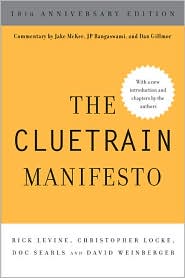
Cluetrain 10th Anniversary edition
Cluetrain 10th Anniversary
Everything Is Miscellaneous
Small Pieces cover
Small Pieces Loosely Joined
Cluetrain cover
Cluetrain Manifesto
My face
Speaker info
Who am I? (Blog Disclosure Form) Copy this link as RSS address Atom Feed

February 6, 2002

First Review The first review

First Review

The first review of my book Small Pieces Loosely Joined: A Unified Theory of the Web has appeared. It’s from Kirkus, one of the four early review publications, intended for bookstore owners, book review editors, and librarians. (By the way, have I mentioned just how sexy sexy sexy are bookstore owners, book review editors and librarians? It’s true!)

Here’s what I think is a fair excerpt of the review, with some explanatory interjections:

A Web visionary’s [That’s a promotion from “garrulous asshole,” right? Or is it a synonymn?] largely [“largely” means “very very” in the English, am I correct?] successful attempt to place the new medium within a social and cultural context.

…though his subtitle is a bit premature [I say: Why wait?], his presentation remains straightforward, avoiding the McLuhanesque convolutions that embellished, and often obscured, attempts to understand the previous new medium of television… Weinberger looks at the effects the Internet has had on every institution it touches, from business, to education, to government [Actually, I don’t, but this seems like a better book than I wrote so we won’t quibble]. Terming the Web both a “wanker’s paradise” [Heh heh, they said “wanker”] and a “collective, global work of literature,” the author concludes that … the Web hype was not “unwarranted, only misdirected.” … The overall focus … is on the social and cultural ramifications of a medium “constantly in the throes [Don’t I get credit for spelling “throes” correctly?] of self-invention.” Conceding that the Web is “profoundly unmanaged” by design, he goes on to describe a realm where nearness is based, not on contiguity, but on similarity of interests, where, in a paraphrase of Andy Warhol’s bon mot, “everyone will be famous to fifteen people.” At the opposite end of the spectrum from the pointy-headed digerati elite [What do you have to do to get a pointy head around here???] …. Weinberger is a democrat who sees the Web not as a medium of mass stupefaction like TV but as a new and intense form of social interaction [Um, except for all the wanking]. He concludes on the hopeful note that the Web can be a “place free of what’s been holding back our better selves.”:

The premises here are ultimately neither radical [Damn, I told my editor I should have said “fuck” more!] nor obtuse, and readers with a general familiarity with the Web will be prepared to understand these coherent and cogent arguments [Slashdotters excepted].

Let’s see how that blurbs: “Web visionary … successful attempt … McLuhanesque … pointy-headed … profoundly unmanaged … mass stupefaction…” It’ll look great on the book jacket!

Tweet
Follow me

Categories: Uncategorized Tagged with: uncat Date: February 6th, 2002 dw

Be the first to comment »

February 5, 2002

Foucault Again and the New

Foucault Again and the New Weirdness of Words

A couple of you have pointed out that the Foucault
text I blogged about yesterday (was it just
yesterday? Disk crashes seem to dilate time) is
available
online
. (Thanks Camille, thanks John
Harrison.)

Jacob Schwirtz of gazm.org writes about “parrhesia,” the topic of Foucault’s lectures:

when studying the Talmud, in the
original
Aramaic, there is a word used often, “Pharhessia”
(phonetically spelled), which means “in public.” Not
sure it has any connection to the Greek word but it
got me thinking…

If it’s a coincidence, it’s an interesting one.
Apparently “parrhesia” in Greek comes from roots
that mean “say everything,” which I assume (= guess)
refers to the fact that the person engaging in the
fearless speech that is parrhesia isn’t holding back
any of the bad news — frank and full disclosure.
But, since this type of speech was especially
valuable in the public forum (although it also
characterized the speech of an advisor to an
authority), the connection to the Aramaic is
suggestive. Words are funny things, aren’t they?
They could practically be cute little woodland
creatures if they were anything like them.


AKM Adam, has starting blogging recently. He’s a professor and minister and seriously interesting. He’s also a lovely writer. He questions my claiming that

concepts today that no longer make as much sense as they once did [are:] Privacy. Friendship. Employee. Politeness. Sincerity.

He suggests “distance” as a more likely term

since the Web both makes possible friendships between distant correspondents in ways that Aristotle would have dismissed as impossible, but the same technologies further conceal from me the extent to which my high-bandwidth lifestyle separates me (and sets me at odds with) others.

My response is that “friend” is fracturing the way “parrhesia” did in the 4th-5th centuries BCE because of the distancelessness (and other weirdnesses) of the Net. Take my relationship with Adam as an example. We’ve never met in the RW. We probably never will. We’ve exchanged several emails a day for the past few days. We’ve been probing each other’s interests, senses of humor, incipient assholism (guess what: I win!), and verbal body language. And more. I’ve already learned more than he thinks from him, both explicitly and watching how he thinks and talks. (More about that tomorrow.) Yet, I’m quite reluctant to call him my friend. But I don’t have such personal and intensely intellectual conversations with acquaintances. We don’t have the vocabulary yet.

That’s what I meant.

Tweet
Follow me

Categories: Uncategorized Tagged with: uncat Date: February 5th, 2002 dw

Be the first to comment »

Diskless Wonder Welcome to Day

Diskless Wonder

Welcome to Day 2 of “Hey, Kids, Let’s Rebuild XP!”

I spent the first six hours of yesterday determining that I was not going to be able to recover my 60 gigabyte drive and another three finding out that, despite its reluctance to be noticed by my BIOS or XP in the early stages of rebuilding, my 20 gigabyte drive — the one with the backups on it — was in fact intact. Another 10 hours rebuilding my system and I’m almost minimally functional again.

Pardon me, but does anyone know the right spelling of “Aaaaaaaaarrrrrrrrrrgggggggghhhhhhhhh”?

Here’s where being a paranoid pessimist pays off:

I back up every night, albeit using a rather primitive method: I run batch files that invoke Winzip. The daily backups go onto my computer’s second hard drive … the one that looked like it was gone. Every couple of days, I back up my backups onto my kids’ computer on our home network. Unfortunately, I only back up my 650MB Outlook data file once a week. (Yeah, I know it’s too big.)

I use XP’s save-your-settings wizard so that I can restore my Office apps’ settings, including IE’s favorites. (For some reason, however, the Outlook Rules Wizard needs to be reminded by hand the destinations for the messages I want filtered into various folders.)

I pay $50/year to have my Quicken files (and other files, up to a 50MB limit) backed up on some Web server somewhere. I’ve never had to restore from there before, but I did last night, and it really really worked.

Just a few days ago, I downloaded the 30-day trial of v-com’s AutoSave. It supposedly updates your archive every time you save a file. I’ve found it to be a really annoying piece of software to use — the type of UI that has you saying “Green … blue … green … blue” like Bruce Willis trying to figure out which wire of a homemade bomb to clip. I thought I had saved 7GB of compressed info onto my backup disk, but I couldn’t figure out how to to tell it that that file had changed positions (because in the re-install, drive C became drive F and drive E became drive C and drives D and E had a threeway with a floppy from Encino). Anyway, it turns out that AutoSave wrote uncompressed files that I could restore just by dragging and dropping. Cool error!

I remembered to backup my backup scripts and my password list.

Ah, the sweet benefits of being obsessive-compulsive!

However, all is not sweetness and fresh clover honey here in the Weinberger manse:

I didn’t save my games’ saved games. (No, that isn’t gibberish.) Particularly painful will be getting back to puzzle #50 or so in The Incredible Machine, a game I’ve been playing with my son.

I have done a pisspoor job of maintaining Outlook. Even with frequent auto-archiving, the files get too frigging big. I’m sure it was a coincidence, but my disk blew yesterday while compacting my main .pst fie.

I do a piss poor job of offloading truly irreplaceable files such as family photos.

Some files seem like they’re more trouble to back up than to restore, particularly music files. But I was wrong. Facing re-ripping bunches of CDs does not fill me with joy.

I need to write myself better notes. I lose incredible amounts of time trying to remember if Dreamweaver 4 was on a floppy or was a download and I know it’s going to take me way longer than it should to get back to HP’s CD burning software because I don’t remember how.

So, I’ll spend the rest of the day sanding off the rough edges and discovering several holes I’ve punched into the past couple of years. For example, I just found out that the complex Outlook macros I’d written (oh, get off my case, they do what I need done) are gone. Does this rebuilding time count towards the 4,000 hours of volunteer time Bush wants me to put in?

(Volunteerism: What rich people urge the rest of us do because they figure if we don’t have money, we must have a lot of time.)


A word of praise: After 15 years, we as a civilization have conquered the two problems that drove every PC user to the nearest absinthe bottle: You don’t have to spend a full day getting your computer to recognize your CD drive, and XP finds and installs networking software as if computers were meant to talk with one another.

However, the lack of an XP boot disk is maddening. Just take me to the goddamn command line, you motherfuckers! And don’t whine to me about there not being any DOS any more or about how the recovery console does the same thing. I couldn’t use the recovery console because it couldn’t find an installation of XP on my freaking hard drive.

Aaaaaaaaarrrrrrrrrrgggggggghhhhhhhhh! (sp)

Tweet
Follow me

Categories: Uncategorized Tagged with: uncat Date: February 5th, 2002 dw

Be the first to comment »

February 4, 2002

The New Athens? I was

The New Athens?

I was browsing in the book store — the local, physical store, the one with paper and floors and smells and everything — when I randomly opened a book by Michel Foucault and saw that it was about a Greek word I don’t remembering having heard before, parrhesia, which he translates as “fearless speech” (the title of the book). The next book I picked up was by Thomas Merton, and guess what word was on the first page I turned to: “the.” But also “parrhesia.” So, I bought the Foucault book.

To my surprise, it isn’t his usual proof of his own cleverness. It’s instead an immersion in Greek culture, using a change in the meaning of “parrhesia” as a way of showing shifts in the contexts in which the word was important. It moved from meaning the speech of a citizen that fearlessly “tells it like it is” to an authority to a sometimes negative term for rabble-rousing. Foucault wonders how this change could have happened. It’s as if a crack opened up in the word. For example, originally there simply was no question about how the truth-teller knows the truth. But in the 5th century BCE, the question of the justification of belief was indeed beginning to arise. Likewise, Foucault looks at how the socio-political situation had changed so that parrhesia no longer was a simple virtue. He’s brilliant at his exploration of the context within which this word had sense.

This is a bit like a shift in a scientific paradigm, except the old paradigm isn’t abandoned because of the accretion of anomolies that it cannot explain. Rather, there is a dense human context that alters and a concept that made sense becomes problematic. The bits of the old context that no longer make that much sense provide clues to the larger tectonic movements of thought.

So, what are the concepts today that no longer make as much sense as they once did? Privacy. Friendship. Employee. Politeness. Sincerity. The Web’s knocking each of these for a loop.

Not all the terms are Web-related. For example, courage in an age of high-altitude bombing no longer means what it used to. Maybe civilian doesn’t either. But a whole bunch of these terms spring out of the Net. That may be the biggest clue that important, and potentially scary, changes are afoot.

Here’s the question that excites me so much: Are we in an time that could rival the golden age of Athens in its capacity for reinventing ourselves?

Tweet
Follow me

Categories: Uncategorized Tagged with: uncat Date: February 4th, 2002 dw

1 Comment »

Boston Rulz!!!!!!! (Who cares?) Here’s

Boston Rulz!!!!!!! (Who cares?)

Here’s the highlight of the game — the first I’ve ever watched all of — from my point of view (which happens to be a house five doors outside the Boston city line). As it looked like the Patriots might actually win, our 16-year-old daughter looked at our 11-year-old son, noted the realistic doubts he had consistently expressed, and pronounced:

“You don’t deserve to loot.”

Tweet
Follow me

Categories: Uncategorized Tagged with: uncat Date: February 4th, 2002 dw

Be the first to comment »

February 3, 2002

Please Be Me Want to

Please Be Me

Want to see one of the weirder ways the concept of the self is being stretched on the Web? Go to DavidStill.org where Mr. Still lets you send mail as him. His “about” page says:

You are David Still, 32 yrs old, and a recent emigrant to Almere, Netherlands. You work as an IT Consultant for a small but expanding start-up business that specializes in communication systems. This you enjoy, as it gives you plenty of opportunities to meet new people. You also like where you live, it’s clean air, well planned cycle paths and neighbourhoods, and the newness of it all. Your home, that you live in on your own is called the Sail Tower, is close to Noordenplassen (North Ponds), where you often go for a swim, as part of your new lifestyle, though you still continue some of the bad habits you had from your previous life. In your spare time you like to work on your website where you offer the use of your identity to other people.

So, as we wrestle with the problem of maintaining a secure and reliable identity on the Web where we lack identity’s traditional anchor — I refer to your fat ass — here comes this joker that subverts the whole concept. Bless him and all his little pseudo-hims.

(Thanks to Tom for pointing this out and Halley for forwarding it.)

Tweet
Follow me

Categories: Uncategorized Tagged with: uncat Date: February 3rd, 2002 dw

Be the first to comment »

February 2, 2002

The Problem with Voice, Part

The Problem with Voice, Part 2

David Rogers responds to my blog about whether corporations can have a voice:

I’ve been thinking about yesterday’s blog on voice for quite awhile—and finally put my thoughts down right here on my blog.

You might want to read this entry on Mark Twain and voice first.

Ultimately, I’m struggling about your assertion that a corporation can’t have a voice on the Web. You’ll see that I try to assert that it is possible—just rare and difficult.

David’s blog on this topic is thoughtful and I think hits the nail on the head … although I disagree with the direction he drives it. He thinks a corporation can have a voice, although he’s careful about this.

David writes:

When I speak of “voice” on the Web, I primarily mean “authentic, sincere, with human qualities and values”—more or less the kind of voice you’d hear in a conversation or letter from a dear friend. OTOH, I sense that to DW and the Cluetrainers “voice” means “human, coming from a truly individual human source, authentically speaking that person’s thoughts and ideas.”

I think the problem is indeed in our definitions. I’d say that authentic voice does come from a real human being speaking the thoughts and ideas that matter to her. If you take the human out of the equation, how can the voice be sincere? What’s the what that’s speaking its mind?

David takes Walt Disney as his main example:

…Walt Disney shamelessly promoted his original theme park on television in what were nothing more than 60 minute infomercials. Yet the public loved it! The secret was Walt’s voice. He gosh-gollied and aw shucks-ed his way through every episode. Ratings skyrocketed and Walt built a huge audience for his new Disneyland park.

It is certainly the case that a spokesperson can speak for a company authentically and in a real voice. To some extent, Ben and Jerry, William Ford, and Jeff Bezos do this. And, in some small companies, that one person does all the marketing writing; Seth Godin points to Norh, a tiny Thai stereo speaker company, but even its voice has degraded as it has grown, for at some point, Disney, Ben, Jerry and William all hire marketing writers who now adopt (= mimic) the voice of their chieftains. And now there’s a human being writing inauthentically. Hell, I spent enough years doing it.

There are two other possibilities for authentic voice emerging from a company in addition to having a leader who speaks for herself. You can miraculously get everyone you hire to believe in what you do and to sound exactly like the corporate style authentically and of their own free will. Ok, so scratch that. The other possibility is to set free the myriad of voices in your organization. Let 1,000 employees bloom. Let them speak for themselves about what matters to them and what they care about. Scary as shit, but do it. Why? Because your employees are already out on the Web doing it … that is, if they care about your products at all.

Only by so doing can your corporation have an authentic voice … because its voice consists of the individual voices of actual, living, breathing people.

Tweet
Follow me

Categories: Uncategorized Tagged with: uncat Date: February 2nd, 2002 dw

Be the first to comment »

February 1, 2002

Silicon Nostalgia John Harrison, Pastor

Silicon Nostalgia

John Harrison, Pastor of the United Methodist Churches of Sheldon, Bronaugh, and Moundville, Missouri and author of Learning to Float writes in response to my blogging about a site about the KayPro computer:

I bought my first computer in 1984, a Kaypro 4-84, back when we thought 64K was a heckuva lot of RAM, and who needed hard drives, anyway? That machine did quite a bit of work for me as a managing editor for a financial newspaper, and then it got me through three years of seminary. Even as low-powered as they were, they were workhorse machines for word processing and spread-sheeting. Although I have gone through five computers since then, I still have that eighteen-year-old machine with me.

I gave mine up when I got my first IBM PC (actually a Zenith … such an early model that there were hand-soldered wires on the motherboard to correct some recently-discovered bugs). I typed my wife’s dissertation on the KayPro, wrote an endless series of articles and columns and papers, and learned how computers worked. One of the great things about the KayPro (caution: Old Timer story about to commence) was that they were simple enough, in both their hardware and software, for a beginner to figure out. Assembly language for the Z80 chip wasn’t all that arcane, whereas you need a doctoral degree, an oscilloscope and a miner’s hat to figure out how to program one of the modern Intel chips. And you could get a map of the KayPro motherboard, neatly labeled, from MicroCornucopia and actually understand the electronics — sort of like tracing routes on a map of the NYC subway system. Ah, for the good old days when I had to trim a vowel from the help screen for a file manager I’d written in order to keep it under 4K.

On the other hand, I love my 1.7gH PC with the ludicrous 512MB of RAM it needs to run well. I still watch the graphics of games like Castle Wolfenstein, Ghost Recon and Serious Sam in awe. Rather than having one or two “terminate and stay resident” programs in the background, I routinely have 10-15 apps open on my desktop at a time. And it makes me giddy to think that even our best machines are banging rocks together compared to what’s to come. Give me more!

Tweet
Follow me

Categories: Uncategorized Tagged with: uncat Date: February 1st, 2002 dw

Be the first to comment »

« Previous Page


Creative Commons License
This work is licensed under a Creative Commons Attribution-NonCommercial-ShareAlike 3.0 Unported License.
TL;DR: Share this post freely, but attribute it to me (name (David Weinberger) and link to it), and don't use it commercially without my permission.

Joho the Blog uses WordPress blogging software.
Thank you, WordPress!