



logo
EverydayChaos
Everyday Chaos
Too Big to Know
Too Big to Know
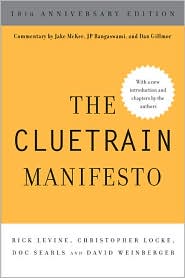
Cluetrain 10th Anniversary edition
Cluetrain 10th Anniversary
Everything Is Miscellaneous
Small Pieces cover
Small Pieces Loosely Joined
Cluetrain cover
Cluetrain Manifesto
My face
Speaker info
Who am I? (Blog Disclosure Form) Copy this link as RSS address Atom Feed

January 10, 2002

Talking Like a Human Also

Talking Like a Human

Also from Peter “peterme” Merholz comes a small software company that hasn’t gotten so successful that it’s lost its sense of humor. Here are the Omni Group’s software licenses for three of its products:

1. Once you are addicted, you’ll doubtlessly want to spend less than $25 to buy a license. Buying a license enables you to add new items to and edit existing items in documents with more than twenty items. Click here to buy, and in the process help pull America out of this pesky recession. We guarantee we’ll turn around and spend the money you give us!

2. OmniWeb 4 for Mac OS X can be used for free, but occasionally you might get little flashes of guilt while you use it. If this overwhelms you, why not buy a license at our web store?

3. Once you’ve used OmniGraffle for a while, we bet you’ll want to edit documents with more than twenty items, and then you can buy a license to fully enable the app, and help get us that much closer to being _feelthy steenking rich_. Well, OK, maybe not rich, but successful enough to write some more apps you’ll love. And, hey, right now Graffle’s about half the cost of some other visualization tools. Also, we’re a small company, like those juice guys, so when you buy an app from us it gives you a warm fuzzy feeling in your tummy, like if you ate some sweaters.

It really doesn’t take much to connect with your users.

Tweet
Follow me

Categories: Uncategorized Tagged with: uncat Date: January 10th, 2002 dw

Be the first to comment »

Place and Space Peter peterme

Place and Space

Peter peterme Merholz, noticing a blogthread between me and Jonathan Peterson, in an email points to a rich thread of comments on his site about whether it makes sense to think about the Web (and other “information spaces”) as spaces at all. What a bunch of smart people! He suggests starting with the “Stewart’s Chagrin” comment. (Peter also linked to my upcoming book’s discussion of the Web as a place, which generated some good discussion too … citing sources I didn’t know about when I wrote the book. Ulp.)


Jonathan Peterson has counter-blogged:

Use of physical metaphors for information relationships far pre-dates the web, likely even written speech (memory palaces, etc.). While the creation of navigation metaphors based on real-world spaces is convenient, the “placeness” of much of the web cannot be attributed to navigation. Usenet groups have “place” though their metaphor varies depending on the user’s choice of newsreader. Blogspaces are not planned but aggregate through interlinkage of interests. etc.

Good point.

I think the “placeness” if the Web has something to do with the persistence of links. I can “navigate” through a dictionary by using the thumb index, but hyperlinks on the Web provide not just a random and arbitrary way to move, but an pre-existing way to move. I think it also has something to do with the fact that because Web pages are usually carefully formatted by their authors, they don’t feel like information sitting in a database or file system waiting to be retrieved. They feel like they exist with “bodies,” not as mere abstract information or bits. Or something.

Tweet
Follow me

Categories: Uncategorized Tagged with: uncat Date: January 10th, 2002 dw

Be the first to comment »

January 9, 2002

The Shape of a Weblog

The Shape of a Weblog Wave

Gary Turner’s blogstickers have taken off. If you want to see what that means visually, take a look at some charts Gary’s posted showing hits on his site until he gave blogstickers their own home.

Tweet
Follow me

Categories: Uncategorized Tagged with: uncat Date: January 9th, 2002 dw

Be the first to comment »

Place and Voice: Talking the

Place and Voice: Talking the Walk

The Obvious? has some comments on my interchange with Jonathan Peters about the nature of the Web as a “place.” He ties together walking and stories:

More and more I personally derive a sense of place in the internet through a narrative, a thread, making temporary, contextual sense of a sea of information. This is why, for me, blogging is so powerful. It’s what I was getting at in my earlier blog about walking and conversations.

The rest of his entry is just as lovely and insightful.

Jonathan puts voice and place together. The Obvious puts walking and stories together. There’s a coalesence here. I think we’re seeing a good example of blog-style memic development … or what used to be called thinking.

Tweet
Follow me

Categories: Uncategorized Tagged with: uncat Date: January 9th, 2002 dw

Be the first to comment »

Oil Conspiracies and other Political

Oil Conspiracies and other Political Links

From Chip comes a link to a transcript of a CNN piece (Paula Zahn interviewing Richard Butler, the former UN weapons inspector) on a French book that claims that, well, here’s a portion of the interview:

BUTLER: The most explosive charge, Paula, is that the Bush administration — the present one, just shortly after assuming office slowed down FBI investigations of al Qaeda and terrorism in Afghanistan in order to do a deal with the Taliban on oil — an oil pipeline across Afghanistan.

ZAHN: And this book points out that the FBI’s deputy director, John O’Neill, actually resigned because he felt the U.S. administration was obstructing…

BUTLER: A proper…

ZAHN: … the prosecution of terrorism.

BUTLER: Yes, yes, a proper intelligence investigation of terrorism. Now, you said if, and I affirmed that in responding to you. We have to be careful here. These are allegations. They’re worth airing and talking about, because of their gravity. We don’t know if they are correct. But I believe they should be investigated, because Central Asian oil, as we were discussing yesterday, is potentially so important. And all prior attempts to have a pipeline had to be done through Russia. It had to be negotiated with Russia.

Now, if there is to be a pipeline through Afghanistan, obviating the need to deal with Russia, it would also cost less than half of what a pipeline through Russia would cost…

Chip also points us to truthout.com where I found an entertaining column by Michael Kinsley resolving to end his post-9/11 self-censorship. (At least he doesn’t say that if we censor ourselves, we’ve let the terrorists win.)

Hank Blakely hasn’t had a problem with self-censorship. He has a “new home for the disgruntled” where you’ll find his continuing satire of W. He’s added a page of favorite sites where I am honored to find my newsletter in company with the Betty Bowers site who is, as you know, “America’s Best Christian.”

Tweet
Follow me

Categories: Uncategorized Tagged with: uncat Date: January 9th, 2002 dw

4 Comments »

Googlewhacking — Let the Games

Googlewhacking — Let the Games Begin!

Gary Unblinking Stock forwards a forward that forwards a forward, etc., that ultimately comes from Brooks Talley:

… OK, this is kind of embarassing, but I’ve gotten addicted to looking for combinations of common words which have the lowest incidence of appearance on web pages, as indexed by google. So far, I have yet to find a set of two common english words which do not appear together on any web pages.

The best I’ve done with three words is “orangutan popcorn fishwife”, which yields only one result. With four and more words it’s pretty easy to find combos with no results.

Gary responds:

Regarding your habit of googlewhacking (nice triple entendre there):
1: flatness strawberries magnification
1: jeweler parkways pathways
1: florists parkways practiced

This may be too easy: let’s decide what the rules are! Options:

limit the number of letters, per word or total?
must be defined at http://www.dictionary.com?
pluralizations of nouns: valid, or excluded?
conjugations of verbs: valid, or excluded?

I’d nominate some categories, along with the elusive doublewhack:

triplewhack that all begin with the same letter;
triplewhack with words all the same length;
multiwhack beginning with sequential letters (1: applet badger catchy dabble)…

Probably not fair to acknowledge word lists (too easy to spoof) such as that last hit.

Here are the rules I’d like to see: Plurals and conjugations allowed, but the words not only have to be in dictionary.com, the value of the googlewhack goes up the more common the words are. (The exact metric for commonness will be announced later.)

Tweet
Follow me

Categories: Uncategorized Tagged with: uncat Date: January 9th, 2002 dw

1 Comment »

January 8, 2002

Place and Voice Jonathan Peterson

Place and Voice

Jonathan Peterson blogs today about the relation of voice and “placeness.” He says that this line of thought was spurred by one of the online chapters of my new book (ooh, two plugs in a day!) due out in April. I like his pulling together of these two notions, even though we have a semantic disagreement over what constitutes voice. Here’s how I see what Jonathan is saying, from my point of view about voice.

A chapter of my book asks why the Web feels spatial. Here’s what it says. (SPOILERS AHEAD! :) Real world space is an abstraction. Concretely, the RW consists of places, that is, areas that have meaning and emotional tone. The Web consists of places also. But RW places are in space while Web places (sites) aren’t. On the Web, we see places and think “Space!”. But the Web is in fact “place-ial,” not spatial. Its sense of spatiality comes from the fact Web has places that are linked and thus traversable. The links aren’t accidental the way nearness is in the RW; the links express human interest. It’s thus a geography of interest and passion. (It actually is more interesting than that in the book. Really.)

Jonathan links this to voice by noticing the relationship of place and voice on the Web. Web places/sites are written and thus have some type of voice (even if its the phony, affect-less fake voice typical of corporate sites). In a sense, the Web is a spoken place, a “story space” if you prefer (and I don’t). In fact, I like the way Jonathan puts it:

The “placeness” of the internet is the placeness of the marketplace, we know we are someplace when we are overhearing bits of conversation around us and able to step in, introduce ourselves and join those conversations at will.

He’s also got interesting things to say about authenticity and personalization.

Tweet
Follow me

Categories: Uncategorized Tagged with: uncat Date: January 8th, 2002 dw

Be the first to comment »

Passport Required When a program

Passport Required

When a program crashes under XP, you have the option of pressing a button that sends a diagnostic report to Redmond. XP then tantalizes you with the prospect of being told when Microsoft has a fix for the problem. To receive this vital information, however, you are required to sign up for Passport (Tagline: “We called it ‘Passport’ because we’re saving ‘Stranglehold’ for our next product”).

Getting fixes for crash bugs is not a discretionary service. The Department of Justice (Tagline: “It’s called ‘Justice’ to prove we have a sense of humor”) ought to pay attention to this.

Tweet
Follow me

Categories: Uncategorized Tagged with: uncat Date: January 8th, 2002 dw

Be the first to comment »

The Reluctant Egotist Meanwhile,

The Reluctant Egotist

Meanwhile, my book, due out in April, Small Pieces Loosely Joined: A Unified Theory of the Web, has become available for pre-order at Amazon where it currently resides at position #1,956,111, thus edging out such titles as Bryostephane Steereana : A Collection of Bryological Papers Presented to William Campbell Steere on the Occasion of His 80th Birthday (#2,101,446) and Lourdes Gomex-Franca’s El Nino de Guano (#2,107,076), but outranked by the popular Burley Packwood’s Bird turd peppers and other delights. Yeah, well, if I wanted to sell out like that whore Packwood, my book could be #1,467,919, too.

The blurbs have started to come in for my book, but I find I lack the requisite shamelessness. Aw, fuck it. Here’s what Daniel Pink, author of Free Agent Nation, said:

“In the tradition of Marshall McLuhan, David Weinberger has offered a startlingly fresh look at a new medium. But Small Pieces Loosely Joined is more than a work of techno-analysis. At its heart, it is an elegant and ultimately hopeful inquiry into the human condition itself. Once you read this book, you’ll see the web – and yourself – in a whole new light.”

Pink is a really interesting guy, and not just because of the blurb. His book is hugely readable and subtle. You can read why he left his job as speechwriter to Al Gore to become one of this country’s 33,000,000 free agents here.

Tweet
Follow me

Categories: Uncategorized Tagged with: uncat Date: January 8th, 2002 dw

Be the first to comment »

Stately Plump Gonzo Marketing To

Stately Plump Gonzo Marketing

To everyone’s astonishment, Chris Locke’s Gonzo Marketing has been chosen by the Harvard Business Review as one of the year’s top 10 business books, serving notice that Western civilization has officially ended. Tom Matrullo blogs the appropriate commentary on this event.

Tweet
Follow me

Categories: Uncategorized Tagged with: uncat Date: January 8th, 2002 dw

Be the first to comment »

« Previous Page | Next Page »


Creative Commons License
This work is licensed under a Creative Commons Attribution-NonCommercial-ShareAlike 3.0 Unported License.
TL;DR: Share this post freely, but attribute it to me (name (David Weinberger) and link to it), and don't use it commercially without my permission.

Joho the Blog uses WordPress blogging software.
Thank you, WordPress!